Friday, September 28, 2012

"Only a Large Majority Now Supports Plan, Down From Ginormous Majority!"

Jerry Brown Yes on Prop 30I'm writing this post primarily because I think the gist of this article is nuts.  From Chris Megerian and Evan Halper in the L.A. Times, here's the headline:

Support Slips for Brown's Tax Hike

Uh oh! California has a terrible budget problem caused in large part to the basic fact that the legislature keeps spending money without casting the politically perilous votes to raise taxes.  So this year the powers that be have decided to put the onus of a tax hike on the voters themselves.  Proposition 30, backed by Governor Jerry Brown, is one solution that was engineered to affect only the rich and be just modest enough to win a statewide vote, and there are many funding initiatives (like higher education funding) that are tied to it.  So if it goes down, California suffers fiscal-cliff-like spending cuts.  Here's the subheadline:

Backing for Prop. 30 drops to 55% amid concerns about the way lawmakers spend money, poll finds

Wait, 55% is still definitely a solid majority.  Barack Obama is polling about 55% in the latest polls, so 55% is a great number.  But I guess we could be in some sort of transition phase, like what happened in Oklahoma in 2010 with State Question 744, which at one time had polled at 65% in favor to 21% opposed but which ended up cratering 19% for to 81% against on election day.  Is that what's going on here?

... a drop from May, when 59% supported it.

That's ... not that much of a difference.  Four points is not nothing, but the tone of the article makes it sound much more dire.  Maybe the no-votes are rising?  There were 36% opposed in May.

The new poll shows 36% of voters opposed, with the remainder undecided.

So, unchanged. This means the proposition supporters are still leading opponents by a whopping 19 points, 55% to 36%.  

The findings suggest that voters are leery of sending more cash to Sacramento in the wake of a financial scandal at the parks department, spiraling costs for a multibillion-dollar high-speed rail project to connect Northern and Southern California and ill-timed legislative pay raises.

Translation: 4% of voters may be leery of Republican talking points. 

Sixty-three percent of independent voters approve.

Yeah, going down in flames then.


Wednesday, September 12, 2012

U.S. Senate 2012 Predictions: The Bidening

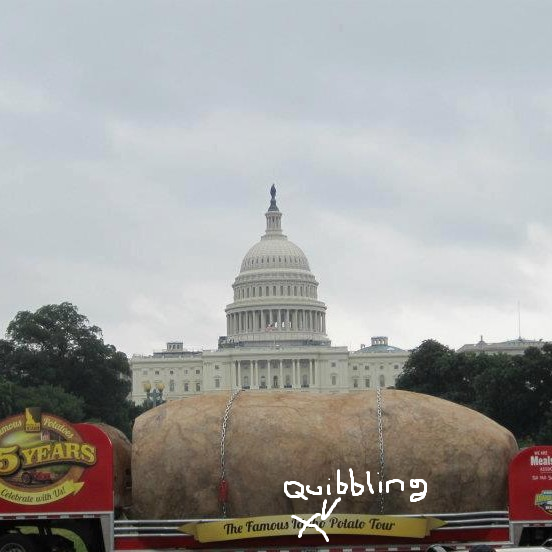
The Famous Quibbling Potato Tour
It's September, the conventions are over, every partisan is fired up and ready to go, and polling firms are earning all kinds of scratch predicting the presidential race.  Seems like there's a new opinion poll regarding Obama/Romney every day.  But while the presidential race is important, every poll says pretty much the same thing: Obama will probably win by fewer electoral votes than he did in 2008.  The really exciting race is for control of the Senate, and a lot of movement in the polls will happen in these last two months.

This is my biennial post breaking down the Senate race.

Right now the Democrats control the Senate 53-47, but only because they pal around with Socialists (Bernie Sanders, I-VT) and a McCain-supporting war hawk (Joe Liebermann, I-CT). But of the 33 seats up for reelection in 2012, only 10 of them are held by Republicans. So our starting baseline is D:30 - R:37

I Just Blued Myself


Delaware
Tom Carper (D) vs. Kevin Wade (R)

Maryland
Ben Cardin (D) vs. Dan Bongino (R)

Minnesota
Amy Klobuchar (D) vs. Kurt Bills (R)

Rhode Island
Sheldon Whitehouse (D) vs. Barry Hinckley (R)

Washington
Maria Cantwell (D) vs. Michael Baumgartner (R)

Pennsylvania
Bob Casey (D) vs. Tom Smith (R)

New Jersey
Bob Menendez (D) vs. Joseph Kyrillos (R)

All these races have Democratic incumbents, all of these will be won by the Democratic incumbents easily, yet all of them aren't exactly what you'd call a household name. (The Bobs on either side of the Delaware River are maybe slightly more famous than the rest of this group.) I only learned just now that Senator Cardin and Senator Carper were two different people. Amy Klobuchar might have had a close race, but the Republicans chose Ron Paul-backed Representative Kurt Bills in the primary.  Sheldon Whitehouse is going to face off against a guy whose last name is 19 Google hits below the guy who shot Reagan.  And Cantwell will beat the guy whose only notoriety in the national media so far is that he told a reporter to "go fuck yourself".   Add seven to the D's.

D:37 - R:37


The Jim Rogers Memorial Is-This-Really-The-Best-Democrats-Can-Do? Races


Wyoming
John Barrasso (R) vs. Tim Chestnut (D)
 
Mississippi
Roger Wicker (R) vs. Albert N. Gore Jr. (D)

Tennessee
Bob Corker (R) vs. Mark Clayton (D)

Chestnut managed to win the majority of the votes cast in Wyoming's Democratic primary despite  not having a campaign webpage and spending just $300 (which works out to about $100 per registered Wyoming Democrat).

Mississippi's Albert N. Gore Jr. is almost a perfect imitation of Oklahoma's own lovable lunatic Democrat Jim Rogers. 1. He's old. 2. He has a similar name to someone well-respected in the region (Will Rogers, Al Gore). 3. He's not at all related to that person. 4. He doesn't have a website. 5. He actually won a statewide primary. The only real difference is that while Jim Rogers observes a strict media silence, Albert N. Gore Jr. (who won't give out his age) has given several interviews. Also, he's seems to possess both coherent policy ideas and more than one shirt. 

Tennessee's Mark Clayton: Tim Murphy of Mother Jones describes him thusly:
Mark Clayton believes the federal government is building a massive, four-football-field wide superhighway from Mexico City to Toronto as part of a secret plot to establish a new North American Union that will bring an end to America as we know it. On Thursday, he became the Tennessee Democrats' nominee for US Senate.
He's more of a Randall Terry Democrat than a Jim Rogers Democrat, I suppose. He's such a social conservative that Tennessee state senator Stacey Campfield, the Sally Kern of Tennessee, proudly called himself a fan and did a joint press conference with him.  The Nashville Tennesseean's article about this is entitled "If liking a Democrat is wrong, Stacey Campfield doesn't want to be right"

So, three easy wins for Republicans.


D:37 - R:40

Big Blue Ladies


California
Dianne Feinstein (D) vs. Elizabeth Emken (R)

Michigan
Debbie Stabenow (D) vs. Pete Hoekstra (R)

New York
Kirsten Gillibrand (D) vs. Wendy Long (R)

These three Democratic women represent (and will continue to represent) 66 million people. The three previous Republican men represent (and will continue to represent) 10 million people.

D:40 - R:40


Berg and Re-Berg


North Dakota
Heidi Heitkamp (D) vs. Rick Berg (R)

Montana
Jon Tester (D) vs. Denny Rehberg (R)

Rehberg and R. Berg are destined to be the next two U.S. Senators Whose Names I Mix Up (sorry Cardin/Carper).  They are both Republican and they both are currently the U.S. Representatives for the at-large districts in their states.  Representative Berg should have no problem ousting former state attorney general Heidi Heitkamp, but current U.S. Senator Jon Tester, who barely squeaked by in a Democratic wave election in 2006 (the Thumpin') should give Representative Rehberg a harder time, though I'm still predicting a Rehberg win.  Can't stop the 'stache.

D:40 - R:42


Tea Party Victories = Republican Victories


Texas
Paul Sadler (D) vs. Ted Cruz (R)

Nebraska
Bob Kerrey (D) vs. Deb Fischer (R)

Indiana
Joe Donnelly (D) vs. Richard Mourdock (R)

Tea Party groups primaried the establishment Republicans in these three races this year and are now in good position to win the general election.  Cruz, fresh off his speech at the RNC, has now been anointed as a new conservative star.  Fischer has been the brightest endorsement success so far this election season for fading star Sarah Palin.  Mourdock faces the toughest challenge of this group, but his Club for Growth-fueled money advantage should carry him to victory in a red state against an opponent who voted for Obamacare.

D:40 - R:45

Tea Party Failures = Republican Victories


Wisconsin
Tammy Baldwin (D) vs Tommy Thompson (R)

Utah
Scott Howell (D) vs. Orrin Hatch (R)

Hatch got through Utah's weird convention process only slightly scathed by a Tea Party-backed upstart and will win a huge reelection victory over token opposition Scott Howell.  Wisconsin is a bit of a different story.  The establishment candidate, former governor Tommy Thompson, did manage to win in the primary over a conservative Tea Party-backed opponent, but will face a challenge against a strong opponent who is looking to be the first lesbian U.S. Senator, Tammy Baldwin.  Despite having  terrible campaign signs, I think Tommy Thompson will still be able to win this race based on name recognition and centrism. 

D:40 - R:47

Wait, We Have to Vote Against These Losers Again?


Connecticut
Chris Murphy (D) vs. Linda McMahon (R)

West Virginia
Joe Manchin (D, technically) vs. John Raese (R)

The term "perennial candidate" is not just for low-budget crazies like Jim Rogers and Vermin Supreme.  Linda McMahon and John Raese both are well-funded perennial candidates who don't let a little thing like losing to a Democrat in a U.S. Senate race in 2010 stop them from losing to a Democrat in a U.S. Senate race in 2012.  Hell, Raese is even looking forward to losing to the same Democrat he lost to two years ago!

D:42 - R:47

Blue State Democrats Doing Whatever the Hell They Want


Hawaii
Mazie Hirono (D) vs. Linda Lingle (R)

Vermont
Bernie Sanders (I) vs. The World (D & R)

Vermont's Bernie Sanders is an actual Socialist, as every news article about Bernie Sanders will tell you.  I'm pretty sure he spends every day in elected office just blogging for the Huffington Post.  He'll get 6 more years.  Democratic representative Mazie Hirono won her primary and will now spend the rest of election season chillaxing with Republican representative Don Young of Alaska. 

D:44 - R:47

Florida and Ohio, Florida and Ohio, Every Single Election Year It's Always Fucking Florida and Ohio


Florida
Bill Nelson (D) vs. Connie Mack IV (R)

Ohio
Sherrod Brown (D) vs. Josh Mandel (R)

These senate races are two of the more heavily polled in the nation, partly due to the fact that they are going to be close and partly due to the fact that the polling firms are polling in these states for the presidential race (which will also be close).  These polls have the Democrats up by a couple points.  Both races feature incumbent Democrats fighting off cocky, strident, odd-looking conservatives (Josh Mandel looks like a 16-year-old high school speech club president ...


... and is it just me or does Connie Mack resemble, like, Pacman or something?


It's just me?  I thought so.)

I predict Democrats will just barely squeak by in both races.

D:46 - R:47

Commonwealth Superstars


Virginia
Tim Kaine (D) vs. George Allen (R)

Massachusetts
Elizabeth Warren (D) vs. Scott Brown (R)

All four of these candidates are political heavyweights who bring lots of national attention and fundraising ability to their races.  Tim Kaine went from the governorship to being head of the DNC, Elizabeth Warren went from setting up the Consumer Financial Protection Bureau to being every liberal's dream come true, Scott Brown went from Cosmo's centerfold to owning a truck to being the deciding vote against Obamacare the first time around, and George Allen went from the governorship to being the first person ever to lose an election because of a "macaca moment".

Polling has occurred in both races since 2011, and these two races have been essentially tied for the entire time (Scott Brown has generally been on top by small margins, Kaine and Allen have been switching back and forth).  I'm putting my blue goggles on and predicting Democratic Party wins in both of these races.  It's hard to see Massachusetts electing a Republican over a hard-campaigning Democrat beloved by New England Democrats, and since I think Barack Obama will win Virginia, it would be more surprising to see Allen win at the same time than it would to see Kaine win at the same time.  Flimsy reasons, I know.

D:48 - R:47

Show-Me Shenanigans


Missouri
Claire McCaskill (D) vs. Todd Akin (R)

Okay, so here's what's happened so far: Claire McCaskill, a mainline non-Blue Dog Democrat, had a low probability of reelection since her state has shifted red in the six years since she was first elected.  So the winner of the Republican primary should have been the candidate to beat in this election.  McCaskill knew this and dog-whistled to the wingnuts in her state that this guy Todd Akin was "the most conservative" Republican in the race, because she believed she had the best chance against him.  The strategy worked and Akin won the nomination.  Then Akin opened his mouth, said some stupid thing about women and rape these days, and McCaskill said "dance, puppet, dance!"

Akin's radical right-wing beliefs forced the Republicans to walk back their support for him; they urged him to drop out of the race because any other registered Republican would have a better shot at victory than Todd Akin.  As a woman and a Democrat and the opponent of a misogynist, McCaskill could be expected to weigh in with vitriol and umbrage over Akin's words along with the rest of America, but instead McCaskill has refrained from attacking him, keeping her campaign positive and letting Akin's support be eroded away by his own words.  She's brilliant!  Here's an article about the gamesmanship in this race so far.

Akin's petard-hoisting not withstanding, Missouri is looking less like Nellytown and a lot more like Branson these days.  I think Akin's name on the ballot results in only a 2-point Republican win rather than a 12-point Republican win.  But this is assuming Akin doesn't open his mouth again, which is a sketchy proposition.

D:48 - R:48

Sonoran Poll Desert


New Mexico
Martin Heinrich (D) vs. Heather Wilson (R)

Arizona
Richard Carmona (D) vs. Jeff Flake (R)

Nevada
Shelley Berkley (D) vs. Dean Heller (R)

Polling has shown Heinrich and Heller with consistent single-digit leads and support in the high 40's.  Polling in Arizona's Senate race has shown ... hardly anything because the race has only been polled two times in the last three months.  Both of those polls show an unexpected tie, but support for both candidates in the low 40's with a large number of undecideds.  Arizona is a red state, and polls conducted before Arizona's primary showed Flake with a huge lead over all Democrats.  But since Arizona isn't predicted to be close in the presidential race, few have bothered to poll for the Senate race.  I can't imagine that this poll desert will last, but since I don't have much information to go on, I'm going with the consensus and saying Flake will win.

D:49 - R:50

The Swing Senator


Maine
Cynthia Dill (D) vs. Charlie Summers (R) vs. Angus King (I)

When Olympia Snowe announced she would retire earlier this year, there was a brief period of time when the nation cared about Maine politics.  That window of time closed by the end of June when three polls showed former governor Angus King with a 25 point lead over all comers.  The comers do not include popular Democratic representative Chellie Pingree, who would most likely be able to beat any single Republican for the seat.  This got Republicans talking about how King must have made a deal with Democrats to keep their good candidates off the ballot in exchange for King caucusing with the Democrats if he were to get elected.  King basically said "Hogwash!" and that he was running to bring bipartisanship back; he wouldn't decide which party, if any, to caucus with until after the election.  But the consensus among political reporters is that the Obama-voting same-sex-marriage-supporting Obamacare-backing environmentalist will probably caucus with Democrats.  Just a hunch.

D:50 - R:50

Obama wins, Biden breaks ties (seems like I say this every time; one of these days it may come true), and the Dems control the Senate.  That's my official guess.  But a lot of chips have to fall the Dems way in order for this to happen.  I'm predicting all Democratic wins in the blockbuster races in Florida, Ohio, Virginia and Massachusetts.  Going 4 for 4 in those races seems sort of unlikely.  Really, what was I thinking? It's like I started working on this post a month ago and only just now got around to finishing it. 

Tuesday, August 21, 2012

The Real Scandal: Akin Means It, Missourians Will Still Vote For Him


legitimately stupid
Two things on Republican responses to Akin:

Using the wrong words in the wrong way would indicate that the message conveyed was not the message intended.   The message conveyed by Akin was that he believed women who are “legitimately raped” can’t get pregnant.  It is pretty clear that he intended to say women who are “forcibly raped” are less likely to get pregnant. He even said in his first apology on Mike Huckabee’s show that instead of “legitimately raped” he meant “forcibly raped.”  Oh, okay.  How is that better?  The outrage is still there, the science is still junk. 

Compare this to the faux outrage about Barack Obama’s statement from a few weeks ago, the one where he slipped in the phrase “if you’ve got a business” before returning to a phrase about building roads and bridges – “you didn’t build that”.   The message intended tangentially related to businesses; it was about government’s role in infrastructure that all businesses could take advantage of.  But the message – conveyed in a billion Republican-funded ads from now until November – was that Barack Obama doesn’t think business owners built their own businesses.  Ha ha, Barack, gotcha! 
If the punditocracy is playing “gotcha politics” and deliberately misinterpreting Akin’s words, it serves only to turn a false and offensive statement into a false, offensive, and ludicrous statement. 

You know who is immune from Missouri-based non-storm?  Ben Smith of Buzzfeed.  Akin's views may be out of the mainstream of America, but they fit right in with the mainstream of religious conservative thought.  And the conservative voters of Missouri are the only ones that Akin is beholden to.  

All this scorn from “establishment Republicans” plays right into his hands.  It’s like the whole of America’s political journalists forgot what happened two years ago when the cranky Tea Party ran on a platform of setting fire to the Washington establishment, and they won!  Or even how Claire McCaskill herself manipulated the Republican electorate in Missouri just a few weeks ago by calling Akin a dangerous outsider, knowing this was just the sort of label that would get right-wingers to vote for Akin over more electable opponents.  And now he’s supposed to be in danger of putting the entire state of Missouri in jeopardy of falling into Democrats’ hands?  Everyone knew he was going to say some crazy shit at some point in this campaign.  Claire McCaskill sure knew it!  I mean, all I’m saying is that Missouri’s Republicans all knew what they were getting when they voted for Akin in the primary, so I don’t think Missouri is any more or less “in jeopardy” than on primary day.  Of course he's sticking it out, Scott Brown et al.  Your condemnation only fuels him!

 My hope is that widespread exposure to Akin’s words will increase Democratic turnout in Missouri, because it’s not like Republicans aren’t going to show up anyways. 

Thursday, August 16, 2012

Obamacare, Ryancare, it's the Same Damn Concept!


I was listening to an episode of the Diane Rehm Show today (because I’m a senior citizen of course) and the topic was Paul Ryan’s budget.  They got into a discussion about Medicare and the “premium support” plan that Ryan’s budget would eventually implement where elderly individuals would be given a stipend to purchase insurance in health exchanges which would be regulated by the government.  You know, the policy that would “end Medicare as we know it”.  Predictably the Republican in the discussion, Grace Marie Turner of the Galen Institute, voiced strong support for Ryan’s plan, while the Democrat in the discussion, Jared Bernstein of the Center on Budget and Policy Priorities, voiced opposition.   Later on in the discussion, the topic switched to Obamacare, a plan that would give poor individuals a stipend to purchase insurance in health exchanges which would be regulated by the government.  The roles were reversed.  Jared Bernstein touted this plan, calling it “the right way” to solve America’s health care problems, while Grace Marie Turner expressed concern over Obamacare’s drastic cuts to Medicare service providers.  

Since Paul Ryan was selected as Mitt Romney’s running mate, Democrats have worked to expose the bad parts of Ryan’s premium support plan.  It will ruin the existing system as we know it and will lead to higher deficits in the future.  What are the arguments Republicans have long made against Obamacare?  That it will ruin the existing system as we know it and will lead to higher deficits in the future.  

How can we as Democrats defend Obamacare but condemn Ryancare? This doesn’t make sense to me.  Democrats rail against Ryancare about how the cost of the support stipend won’t increase each year at the rate of medical inflation, which will lead to seniors having to pay out-of-pocket for coverage they used to get for free.   But the rate of increase of the Obamacare stipend for poor people in the exchanges is tied to the poverty rate, which does not increase at the rate of medical inflation, and everyone is paying out-of-pocket for coverage already.  You know what one difference is between the two plans is?  Ryancare actually has a public option in its exchanges (Medicare).

So Paul Ryan seeks to get rid of a system with a guaranteed benefit in order to replace it with a system of government-regulated capitalism.  And Barack Obama seeks to get rid of a system of exploitative corporate shadiness in order to replace it with a system of government-regulated capitalism.  I can see that each party is motivated to defend the direction in which the proposed systems are moving, but they’re both ending up defending government-regulated capitalism using basically the same arguments for and against.  

As Ezra Klein points out, "[this] has left the two parties in a somewhat odd position: Democrats support the Republicans’ old idea for the under-65 set but oppose it for the over-65 set. Republicans support the Democrats’ new idea for the over-65 set but oppose it for the under-65 set."

This leads to confusion and hypocrisy.  Here’s the hypocrisy: the aforementioned Grace Marie Turner defends “programs that give us a great model” featuring “seniors making choices from among competing private plans”, but she also thinks Obamacare’s exchanges, which feature people making choices from among competing private plans, features too many “complex and onerous bureaucratic rules” that throw up “barriers to competition and consumer choice”.   And on the other side: Barack Obama has labeled the system that joins a mix of private insurance options with one public option (Medicare) as “thinly veiled social Darwinism”, but when he proposed creating a health insurance exchange joining a mix of private insurance policies with one public insurance policy (the Public Option), he characterized it as a system that would “provide more choice and more competition,” one that would “keep the policies affordable”.  

Is it possible for people to be both for market-based health care reforms and against market-based health care reforms?  I guess so, because everybody is. 

Sunday, July 15, 2012

Why isn't my Starbucks being taxed?

I hardly ever post on this old political blog of mine, but when I do, I try to mix in an even amount of Oklahoma posts with national political posts.  This ratio is probably going to change though.  I now live in California. 

California politicians seem to be completely the opposite of Oklahoma politicians.  I mean, as far as I know they still haven't even discussed the issue of fetuses in our food, and the perpetrators of the genocidal slaying of California's innocent zygote people remain at-large.  Also of note: Californian legislators seem to have no problems with spending money they don't have, as demonstrated by the $8 billion future boondoggle that will be the Central Valley high speed rail project.

Another striking note of difference between Oklahoma and California: California's politicians are putting a tax increase on the November ballot; they are under the impression that a majority of the people of California are willing to raise taxes on themselves.  I don't know if this a realistic assumption or not, but I do know that any effort by an Oklahoma politician to put a tax increase on the ballot would surely be a sign of that politician trying to kill the tax increase.  In 2010 Oklahomans overwhelmingly rejected a ballot measure that would have increased state spending on schools, in part because of the suspicion that taxes would necessarily have to be increased sometime in the future.  If the measure had included these tax increases in the ballot language, the margin of defeat would have increased from 60% to something like 90%, probably. 

But for all the legislative acceptance of higher taxes as a solution to the fiscal problem, there seem to be loopholes that don't make much sense to me.  One of the first things I noticed when moving here was that my Starbucks was cheaper than in Oklahoma.  I soon realized that this was because my grande hot chai tea latte wasn't being taxed for some reason.  For such a progressive state, it made absolutely no sense to me that $4 coffee from Starbucks, far from being a necessity of life, was being treated like grocery store food. 

I searched around online for a reason for this and came across this excellent article and flowchart from the SF Weekly from April of this year.  One of the points of the article is that the tax system for food is highly and arbitrarily convoluted:

A hot sandwich to go would be taxable, while a prepackaged, cold one would not — but a cold sandwich becomes taxable if it has hot gravy poured onto it. Cold foods to go are generally not taxable — but hot foods that have cooled are taxable (meaning a cold sandwich slathered in "hot" gravy that has cooled to room temperature is taxable). Cold, non-carbonated, non-alcoholic beverages to go aren't taxable. Hot beverages to go are, but coffee and tea are specifically exempted from taxation. Soup, however, is taxable. Hot soup that has cooled? Still taxable. But, the BOE specifically informs SF Weekly, cold soups such as gazpacho are exempt.

But the more important point behind all these exemptions is that it is costing the state billions of dollars in tax revenue.  "In the current year, California's Department of Finance estimates revenue losses from exempting food and bottled (non-carbonated) water to be nearly $10 billion."  $10 billion would be about half of the state's predicted costs for the entire high-speed rail plan from San Francisco to Los Angeles - and about twice the state's costs for the recently-approved Central Valley portion of the plan.  It would be 62% of the $16 billion deficit that California is being burdened with this year.

And all for what? So that we can continue to get tax-free Starbucks? So that I can still go to the grocery store and buy frozen pancakes wrapped around Jimmy Dean sausages tax free?  So that all the rich people who shop at Whole Foods can get their food tax free while the poorer clientele who eat at Taco Bell are forced to pay the nation's highest sales tax rate?  I don't think the state has the right incentives here.

I am normally skeptical about sales tax increases since sales taxes are regressive taxes that affect the poor more than the rich, but it doesn't make any sense to me that California is leaving all that potential Starbucks money on the table when they're trying to slash spending and raise every other tax.  I would think that California would be able to increase revenue while lowering the sales tax rate if they got rid of almost all of these food exceptions, maybe only keeping WIC program food tax free.  Instead, the sales tax rate will be going up a quarter percent if voters pass Proposition 30 in November. McDonald's will become more expensive, but Starbucks will remain tax free. 

But hey, at least we Californians can practice Sharia Law and eat all the fetuses we want.


Friday, June 01, 2012

We Are The 1%: Mitt's Megadonors


R-money, dawg!
Billionaire business owners are rich (duh).

Billionaire business owners didn’t get to be rich by throwing millions of dollars away.  They invest; they do not donate. 

When they throw a million dollars to a super PAC supporting Mitt Romney, they are not doing it solely from the kindness of their own heart.  They are making a purchase.  They seek to buy power, to buy access to the people who make the laws, and they want to make sure that the person signing all the laws in 2013 is the type of person who will only sign laws favorable to them. 

This is why it is so revealing when a billionaire business owner heavily bankrolls a political action committee.  By figuring out who the donors are and what their motivations are, we can deduce what kind of policies Mitt Romney will be an advocate for.

Tim Dickinson of Rolling Stone does excellent work putting together a list of 16 megadonors (defined as a donor who has thrown at least a million bones Mitt’s way), and he has ascribed motivations for each one.  So what do these old white dudes want anyways?  I have summarized Dickinson's list as follows (name – occupation or corporation – what the donor wants from government):

Warriors for the upper class:

  • Edward Conard – Wall Street hedge fund guy – continuing the favorable tax policy for rich people
  • Julian Robertson Jr. – Wall Street hedge fund guy - continuing the favorable tax policy for rich people
  • Robert Mercer – Wall Street guy (non-hedge fund) - continuing the favorable tax policy for rich people
  • Paul Singer – Wall Street hedge fund guy – continuing the favorable tax policy for rich people

Dodd-Frank killers:

  • John Paulson – Wall Street hedge fund guy – weaker banking regulations
  • Kenneth Griffin – Wall Street hedge fund guy – weaker banking regulations / access

Polluters:

  • William Koch – Oxbow Carbon – fewer environmental regulations
  • Harold Simmons – Contran – fewer environmental regulations
  • Steven Webster – Oil and gas guy – pro-drilling policies

Consumer exploiters:

  • Frank VanderSloot – Melaleuca Inc. (pyramid scheme cleaning supplies) – weaker consumer protections / anti-gay policies
  • Steven Lund – Nu Skin Enterprises (pyramid scheme cosmetics) – weaker consumer protections
  • Bob Perry – Perry Homes – caps on jury awards

Quid pro quo:

  • L. Francis Rooney III – Rooney Holdings (construction) – access / patronage
  • Jim Davis – New Balance Shoes – lucrative defense contract

Family friends / fellow New England Mormons born into privelege:

  • Richard Marriott – Marriott Hotels – immigration reform
  • J. Willard Marriott Jr. – Marriott Hotels – immigration reform

You can bet that a Romney administration would share the policy ideas of these donors from the 1%, and those policies would do the following things: cut taxes for the rich, kill off what little banking oversight remains in this country, remove environmental protections, and neuter the Consumer Protection Bureau.  (Maybe there would be room for immigration reform, and maybe not.) 

Not only do these people fund Romney’s campaign, these are the rich people that Romney hangs out with.  These are the friends who own NASCAR teams, private jets and multiple estates.  This is the social group from which Romney derives his worldview, a bleak screw-everything-but-the-bottom-line worldview in which greed is great and capital is king.  Romney was born into this social group and has lived there all his life.  His money is tied to investments with these people (he has at least a million dollars invested with Paul Singer).  He is named after the father of the two Marriott brothers, whose massive New England estate his family “summered” at when he was but a mite of a Mitt. 

These megadonors would not be investing so heavily if there was no big payday somewhere in the future for them.  What the billionaire business owners see in Mitt Romney is a man who will weaken government to the benefit of billionaire business owners.  Their self-serving desires are not good for the country as a whole, but their voices are the loudest (because money is speech and therefore a million dollars is like a speech with a megaphone).  But even if they weren't the loudest, Mitt would still be their man.  He comes from them.  He is of them.  He is just like them, except maybe a little bit younger and more good-looking.  That’s apparently worth a million or two.   

Wednesday, April 25, 2012

Jim Rogers: More Popular Than Republicans!


Last night was the first basically uncontested (sorry Newt, sorry Paul-heads) Republican primary since the media declared that Mitt Romney was firmly, finally the inevitable nominee, the first one since Rick Santorum's frothy surge ended not with a blast but with a dribble (obviously I'm talking about his political surge). 

But the primaries did prove one thing: Oklahoma's Jim Rogers is more popular than the Republican Party in Rhode Island.  15,535 people showed up to the polls in Oklahoma to vote for Democrat Jim Rogers.  Only 14,530 people showed up in Rhode Island to vote for Mitt Romney / Ron Paul / Rick Santorum / Newt Gingrich / Buddy Roemer / Uncommitted / Write-in.  This either means Republicans are unenthused and unpopular in New England, or it means that the Jim Rogers Revolution is just a blimp away from the mainstream!