Showing posts with label Mary Fallin. Show all posts

Thursday, October 30, 2014

Senate predictions: October 30, 2014

Democrats will probably not be winning this Senate election in 2014. There are too many blue lines below the x-axis (8) and too few above (1). Even if I were to be wrong about this prediction (extremely likely), the next two closest races are Georgia and Alaska. In Georgia, a win in November's election for Michelle Nunn just delays the likely runoff win in January's runoff by David Perdue. And polls in Alaska have a history of overstating Democrats' strength. It wouldn't be too surprising if the median poll spread next Tuesday shows Democratic senator Mark Begich with a small lead, but since 2000, Alaska's polls have shown a 7.2 percentage point bias towards Democrats.

As this is supposed to be an Oklahoma blog, I should say something about the elections for both U.S. Senators and all the state offices in Oklahoma: Republicans will win everything by huge margins. Lankford, Inhofe and Fallin will cruise by huge margins, and the Oklahoma Democratic Party will continue to wallow in obscurity and penury for the foreseeable future.  That is all.


Here are today's median poll numbers.

Friday, February 10, 2012

Income Tax Cuts - Mary Fallin's War on the Poor


It has been an absolutely wacky first week of the Oklahoma legislature's 2012 session. Foods containing aborted fetuses? Personhood definitions? This cake featuring Ronald Reagan's face and an extra "W"? This declaration that "any action in which a man ejaculates or otherwise deposits semen anywhere but in a woman's vagina" would be "an action against an unborn child"? This isn't even counting the stuff going down at Night Trips' newest location, the insurance commissioner's office.

But maybe the most important news from this week was officially unveiled at Governor Mary Fallin's State of the State address. Fallin introduced a plan to reduce the Oklahoma state income tax drastically, from a current top rate of 5.25% down to a rate of 3.5% for individuals making more than $35,000 per year or couples making more than $70,000 per year. Fallin said that a family making $40,000 per year would pay 37% less in taxes in 2013. Amazing, right? So, how will we pay for it?

The official word is that the $100,000,000 revenue-deficiency in 2013 and the $300,000,000 revenue-deficiency in 2014 would be made up with the elimination of "loopholes", "credits", "carve-outs", and other words for things that unscrupulous businesses and rich people with personal accountants take advantage of. But, as it turns out, just doing the transferable tax credit stuff still means that the state is "woefully short" on making up the revenue lost. So that means eliminating a bunch of other tax credit programs that normal people use, like the personal exemption (claimed by 83% of tax payers), the earned income tax credit, the child care tax credit, a tax credit used to offset the sales tax for groceries for poor people, et cetera.

As it turns out, Mary Fallin's tax reform proposal would actually result in tax increases for the bottom 55% of income earners, according to the Oklahoma Policy Institute. Now that's broadening the base!

Other ways to pay for Fallin's tax reform proposal, according to Fallin, would be that as a result of shoveling fat stacks of Benjamins into the pockets of the Aubrie McClendons of the state, the state's economy would grow fast enough to overcome the revenue shortfall. "New jobs and increased investments in Oklahoma will lead to more revenue and increased collections in sales tax, corporate tax, excise tax, and more." Tax cuts pay for themselves, y'all. If this smells exactly like an Arthur Laffer supply-side voodoo economics argument-turd, it's because Arthur Laffer's consulting firm helped create the plan with the right-wing think tank Oklahoma Council on Public Affairs.

Oklahoma's economy has grown quite fast since the 2008-2009 recession in part due to our booming energy industry and in part because, well, nowhere to go but up, right? This should mean that bond ratings agencies would look more favorably at the credit rating of the state and its ability to pay back its bonds. But today Moody's announced that it was keeping the credit rating of the state steady, partly because of the tax reform plan, but mostly because our constitution makes it really hard to raise taxes.

From the Tulsa World:

The Moody's report says the state's financial situation is made stronger by a strong state constitutional balanced-budget requirement, a healthy state balance sheet, and substantial oil and gas reserves.

But the agency expressed concerns about the state's past and future plans to cut income taxes.

"The trend of decreasing income tax rates combined with the difficulty in increasing taxes constricts future financial flexibility," the Moody's report says.


So when bad economic times come again, tax reform will cripple the state, and we will be unable to afford many of the functions of government that so many people, at least in part, will depend on to offset the cost of having to pay higher taxes due to said tax reform.

Friday, April 01, 2011

Senator Brian Bingman = Admiral Ackbar


The federal health care bill, lovingly referred to as Obamacare by most Republicans, stipulates that every state needs to set up a health insurance exchange where consumers can access information about cost and coverage of every insurance carrier in the state. It is a free-market idea, one that makes comparing different plans easier and expands consumer choice. But a fully functioning exchange would require some additional investment in information technology infrastructure, which is why the federal government is giving away millions of dollars worth of grants to the states to help them set their exchanges up.


Enter Senator Brian Bingman (R-Sapulpa), the president pro-tem of the Oklahoma Senate. He told reporters that a bill passed by the state House of Representatives that helps establish a state health insurance exchange would not be considered by the Senate. "We're concerned about actually falling into the trap ... of adopting the Obamacare, which is really what we're against," said the Senator, who last month released a joint statement with Governor Mary Fallin and House Speaker Kris Steele (Republicans all) saying he supported the federal grant. Steele and Fallin both still support getting free money from the federal government to better the lives of their fellow Oklahomans. And it's not like these people could ever be described as liberals.


"My hope is that the federal health care bill will either be ruled unconstitutional by the Supreme Court or that Congress might take up legislation to repeal it and replace it with other free-market health care reform initiatives," Fallin said. "But whether that happens or not, the federal health care bill is still the law of the land."


If Oklahoma fails to take action to establish its own health insurance exchange, Fallin warned the federal government will impose its own system on the state.


"I don't think it's helpful to the state of Oklahoma not to have a plan in place," Fallin said. "I also think it puts us on a dangerous path of the Obama administration being able to come in and force a federal exchange on our state."


So Fallin fears a trap just as much as Bingman does. She is just responding a little bit more proactively than he is.


Oklahomans passed a bill last November allowing Oklahoma to opt out of any federal health care law due to a fear of government intrusion (and therefore socialism). The Senate president pro-tem thinks that accepting money from the federal government would trap the state into accepting government intrusion (and therefore socialism). The Governor thinks that not creating an exchange would lead to government intrusion (and therefore socialism).


Our governor, our state leaders, and the majority of state voters are all a bunch of Admiral Ackbars, too blinded by right-wing dogma to see that the whole point of Obamacare is to offer choices to consumers to get us a step closer to universal health insurance coverage.

Tuesday, November 09, 2010

Script Font and Republican Women


The three campaign signs/emblems above all share a few things in common. All three were election signs I saw over and over in the runup to the election. All three candidates (Mary Fallin for governor, Janet Barresi for state schools superintendent, and Sharon Parker for state senate district 16) are women. All three are Oklahomans. All three are Republicans. And all three use a script font for their first names.

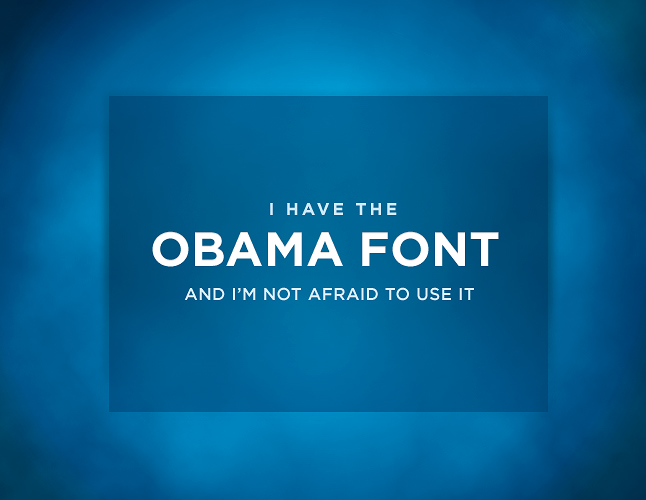
I have a tendency to pay attention to yard signs. I like noticing the color combinations of signs, and I commend those who use colors other than red, white and blue. I like examining the candidates' choices of fonts. We had two district judges in Norman this year who used an all-caps Gotham font with a blue background, consciously evoking the campaign signage of Barack Obama. So I took notice when I saw yard signs for the above campaigns that featured script font, which is an unusual font for campaign signage.

Yard signs generally try to convey a simple message with words: candidate name, office the candidate is running for, and occasionally party affiliation. Everything else on the sign is meant to convey a characteristic that the candidate is going for: bold, strong, effective leader, patriot, statesman. This is why few campaign signs stray from red, white and blue colors, and even fewer stray from strong easily-readible fonts. But the Fallin, Barresi and Parker campaigns strayed from the norm and used script font. Script font gives the impression of femininity and elegance, which can be a nice change of pace in a genre that tends to reward masculinity and bluntness.

Mary Fallin and Janet Barresi were matched up against Democratic women: Jari Askins and Susan Paddack. Neither of their Democratic opponents used script font on their yard signs, although from the picture to the right, it does appear that Susan Paddack had some kind of script font thing for her first name on larger signs, although it's so tiny I don't know why she bothered.


Republican Sharon Parker's opponent was male (he didn't use script font), but running for the state house seat in Norman was female Democrat Emily Virgin. Virgin also refrained from script font. Did they not feel the need to convey to voters their femininity?
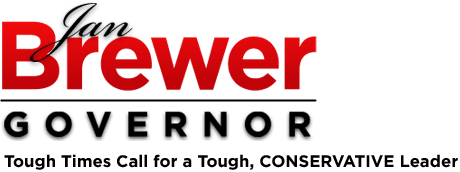

This got me thinking: are Republican women more likely to use script font than Democratic women? The answer: yes!

Republican Sharron Angle, candidate for U.S. Senate in Nevada, used an array of fonts on her signs, but her first name is in a script font on top of her angled "ANGLE".


Republican Jan Brewer, governor of Arizona, scripts the "Jan".


Republican Carly Fiorina, candidate for senator in California, did not use a script font, but she does use a skinny-letter lowercase sans serif that conveys the image of "fashion magazine".


Republican Kristi Noem, congresswoman-elect from South Dakota, uses a very modern fashionable font for her name, but girlies up the "for Congress" part of her sign. I found quite a few campaign signs that had a script font for the "for" part of their sign, which was used by both Democrats and Republicans, but no one else had the balls to use script font for "Congress".


Washington Republicans - congresswoman Cathy McMorris Rodgers's signs feature the name "Cathy" scrawled across the top half of the sign. This photograph found on McMorris Rodgers's website features two other Republicans with script font, senate candidate Dino Rossi and some county commissioner named Mark Richards. This picture must have been taken in the 2008 campaign, because Dino Rossi is listed as running for governor and not senator. He has since changed and modernized his typography.


I can't find any other examples of script type face in political signage from this most recent election, but I think it's strange that it's Republican women who are almost exclusively the candidates to use it. By no means are script-font-users the majority among women candidates or even Republican women candidates, but I would like to know why there are more Republicans who use it than Democrats.

Friday, October 29, 2010

The Friday Before the Election

So Bill Clinton urged Kendrick Meek to quit the Florida senate race in order to possibly swing the race to nominally-independent moderate Republican Charlie Crist over Tea Party-backed conservative Republican candidate Marco Rubio. I first read about this story last night, and the thing that caught my attention was not so much the backroom dealmaking as the presumption that Marco Rubio is on "the cusp of national stardom." I think they may be right. All other Tea Party candidates with high profiles (Christine O'Donnell, Sharron Angle, Rand Paul, Ken Buck, and others) have made some extreme statements about certain things. I have not yet heard of Marco Rubio saying something dumb. An ascendant conservative known having a fiery personality and not known for saying stupid things could definitely gain a higher profile before 2012 or 2016, especially since he will be known in January as Senator Marco Rubio.

Oklahoma's gubernatorial candidates had a debate last night, only five days before the election. The headline I read in the Norman Transcript is "Governor Opponents Boast Right Leanings." Well, just great. It's a race to the right, apparently. Ironically it was the Democrat (Jari Askins) calling out the Republican (Mary Fallin) about her "yes" vote for the TARP bank bailout (signed into law by George W. Bush, but supported by Barack Obama). Jari Askins reinforced her self-imposed "conservative Democrat" label by pointing out how fiscally conservative she was in comparison. The candidates also got asked about Sarah Palin, for some reason. Jari Askins called Sarah Palin a "strong communicator". As soon as Palin is able to communicate her favorite newspapers and her geographic knowledge of the location of Russia, Jari Askins will apparently let us know, presumably while she's "hunting grizzly bears" with her in Alaska. Needless to say, this run for the right favors Mary Fallin, who is against abortion, gun restrictions and health care, and for Arizona's immigration law.

Jim Priest, Democratic candidate for Oklahoma Attorney General, pointed out that his opponent Scott Pruitt has taken $62,000 (7% of his total donations) from poultry companies, which is an issue because of current Oklahoma AG Drew Edmondson's lawsuit against poultry companies in Arkansas for their pollution of Oklahoma waterways. Sure, $62,000 is chicken feed (ha) when it comes to buying influence, but Priest was trying to use it as a way to say that Scott Pruitt is someone who is opposed to clean water regulations from the EPA, and therefore, if elected, Scott Pruitt would be bad for Oklahoma rivers. At least, that's what I think he's trying to say.

Thursday, October 21, 2010

Looking at the Mail

We got 5 pieces of campaign mail yesterday, by far the highest one-day total of this election season. One of them was for the campaign for Yes on 744, the state question that would increase spending on education by 20% without legislator influence. One was for Rusty Sullivan, a candidate for Cleveland County commissioner. I think he's a Republican, but he has what I think is a very effective ad depicting his bipartisanship. On my list of things to look up on the internet before I vote is exactly what the county commissioners do.

Two pieces of mail were from Emily Virgin (D), candidate for our district in the Oklahoma state house of representatives. She won the primary in July in a 4-person race that, judging by local lawn signs at the time, felt like it should have been closer. But Virgin, a former manager for the OU football team, won more than 50% of the vote and avoided a runoff. She canvassed the neighborhood way before I was even thinking about the election, and so when she rang the doorbell, I couldn't think of anything to ask her. Just last week she came by again to get out the vote for the November election, and I was slightly more prepared. Virgin uses the lesson in her campaign literature of a corporate tax break to a private space aviation company called Rocketplane that quickly went out of business as an example of money spent by the legislature that would be better put to use helping out both k-12 and higher education in the state. I asked her how she would be able to tell ahead of time that any particular corporate tax break would hurt the state more than help the state. She gave an answer indicating that it was the transferable nature of the tax break to Rocketplane that should have been eliminated; that Rocketplane should have been required to deliver the results rather than be allowed to sell the rights to the tax break to another company. She was more articulate that I can reproduce from memory. I don't think she answered my question exactly, but she sounded knowledgeable enough and I was impressed with her grasp of the concept.

One other piece of mail came from Aaron Stiles (R), who is running for a house district on the east side of Norman. My family cannot vote for him, so I don't know why we got this mail. But he is running against a Democrat named Wallace Collins, who has the reputation of being one of the more outspoken Democrats in the state legislature. And it got me thinking about the reframing of the health care law passed by the U.S. congress and signed into law by Barack Obama. It has now so thoroughly been relabeled as "Obamacare" that even "respectable" "blogs" like mine tend to refer to it as Obamacare just for brevity's sake. Stiles claims he has the "backbone to stand up to Washington, D.C. and keep ObamaCare out of Oklahoma," and that Wallace Collins voted against a bill "keeping ObamaCare out of Oklahoma". It's a crazy, twisted world when the candidate for office is labeled as soft on health care when he votes against exempting his state from tougher new federal health care laws.

We have not yet received a single piece of campaign mail from any politician running for governor, U.S. senator, or U.S. representative. Tom Cole, our Republican representative, is running unopposed, so this is no surprise. Tom Coburn, our Republican senator, is running against a homeless-looking man named Jim Rogers, a man who doesn't do any campaigning because it's "not his style", and who is one of those "perennial candidates," a class of individuals for whom no long shot is long enough. Tom Coburn definitely doesn't need to do anything to get the vote out. But we have a nominally competitive race for governor between current lieutenant governor Jari Askins (D) and former lieutenant governor Mary Fallin (R). I'm not as tuned in as I should be to local news, but I'm very tuned into yard signs and campaign mail.

Thursday, December 11, 2008

Bailout Hypocrisy from Oklahoma's Congressional Delegation

I'm against bailouts. I don't like the fact that public taxpayer-funded money could go to private companies if said private companies are huge, dying and poorly managed. But I'm warming to the auto industry bailout precisely because the final version of the bill will be dispensing loan money with tight controls, unlike the $700 billion in mostly free money with little control that the House and Senate passed in October. It's also less of a big deal because of the math involved: $19 billion is much much less than $700 billion.

But many senators and representatives don't see it that way. Here's a sampling of the hypocrisy just in Oklahoma:

Senator Tom Coburn:
The labor rates of the Big Three are out of sync with labor rates across the nation and it is unfair to ask American taxpayers to subsidize poor management decisions. The only acceptable Congressional action would be the possibility of guaranteeing loans after labor contracts are renegotiated


Senator Coburn voted yes on the $700 billion Wall Street bailout, which mandated that Americans subsidize poor management decisions.


Representative Mary Fallin:
With our deficit rising and our economy continuing to shrink, cutting every struggling company a multibillion dollar check is simply not an option. The best way to protect American taxpayers is to ask the automobile companies to work through their problems, reorganize their companies and operate by the same rules that other companies and industries have to play by.


Representative Mary Fallin voted yes on the $700 billion Wall Street bailout, which cut many multi-billion dollar checks for dozens of struggling lenders; institutions that now do not have to operate by the same rules that other companies and industries have to play by.


Representative John Sullivan:
Taxpayers should not be asked to reward failure by subsidizing the very business practices that got them into this situation in the first place. Moving forward Congress should focus on helping to rebuild a viable domestic automobile industry through market driven policies, not massive government intervention by nationalizing these companies.


Representative John Sullivan voted yes on the $700 billion Wall Street bailout, which mandated that taxpayers reward failure by subsidizing the very business practices that got lenders into this situation in the first place and created a massive government intervention by partially nationalizing certain companies.


Representative Tom Cole:
Unfortunately, another costly investment by U.S. taxpayers does not guarantee that automakers will reform the habits that caused their current spiral. In fact, a bailout may only encourage the status quo.


Representative Tom Cole voted yes on the $700 billion Wall Stret bailout, which encouraged the status quo.