Showing posts with label Oklahoma. Show all posts

Thursday, November 15, 2012

Romney's Zero-Vote Precincts in Oklahoma: There are Actually Three!

If you've been poking around the right-wing media looking for some of their excuses for why Republicans lost the election (or if, like me, it was brought to your attention by reading this Dave Weigel article), you would have stumbled across this fact nugget: 59 precincts in Philadelphia and 16 precincts in Cleveland tallied zero votes for Mitt Romney.  Zero!  How is it possible that not a single Romney voter lived in any of those 75 precincts?  You could come to one of two conclusions: that the votes recorded are an accurate count of the will of the electorate reflecting the popularity of the current president and/or the deep unpopularity of Mitt Romney specifically and Republican policies generally; or, FRAUD!!!!!11!!

It's not hard to see that these are likely legitimate totals.  Black people make up somewhere close to 100% of the population in these precincts, and 96% of black people went for Obama in Ohio.  There isn't a comparable monolithic voting group on the right, so one wouldn't expect to find as many precincts recording zero votes for Obama as there are precincts that record zero votes for Romney.  Even the reddest county in Oklahoma (Cimarron County, way up in the panhandle) recorded some votes for Obama (9.4%).  So this got me thinking, did Oklahoma have any zero vote precincts for either candidate?  Yes!

Using data from the Oklahoma State Election Board, I made a spreadsheet and some charts.  This was the distribution of precincts in Oklahoma that voted for Obama.  The largest block of precincts (725) gave Obama between 20% and 30% of the vote. 


This is Romney's distribution.  As you'd expect from a state that allows no write-in candidates and no third-party ballot access, it is basically a mirror image of the Obama chart.


But as you can see, four non-empty precincts recorded no Obama votes, and three recorded no Romney votes. Where are these precincts?

Here are the precincts with 100% Romney support (maps adapted from OU's Center for Spatial Analysis).

Kay County, precinct 407 - Romney 34, Obama 0 - wedged between Newkirk and Ponca City on Hwy. 77.


Wagoner County, precinct 105 - Romney 6, Obama 0 - A couple of farmhouses northeast of Broken Arrow


Woodward County, precinct 104 - Romney 6, Obama 0 - Northwest Oklahoma, rural precinct not near anything

Woodward County, precinct 303 - Romney 2, Obama 0 - Northwest Oklahoma, rural precinct not near anything


For those four precincts, it's Romney 48, Obama 0.


Oklahoma County, precinct 237 (near the boathouses) - Obama 4, Romney 0 - There's maybe one house left in this precinct since the new crosstown expressway, the boathouses, Lincoln Blvd.'s realignment and the Boulevard's construction has taken every other property.


Oklahoma County, precinct 188 (the state fairgrounds) - Obama 3, Romney 0 - I guess the three homeless people living on the fairgrounds all like Obama.


Cleveland County, precinct 90 (Moore, north of NE 27th, between I-35 and Eastern) - Obama 1, Romney 0 -  It could have gone either way.


For those three precincts, it's Obama 8, Romney 0.

But this all doesn't tell us much.  Besides that Kay County precinct, these are all fringey precincts with very few people that all have a pretty good chance of voting unanimously just by random chance. What about precincts where the candidates get 95% of the vote or more?

Beaver County, Precinct 13 (way up in the panhandle northeast of the town of Beaver, north of Slapout) - Romney 119 (95.2%), Obama 6 (4.8%) - Over 250 square miles, and only 6 people voted for Obama.


Harper County, precinct 303 (the next county over from Beaver County, east of Buffalo) - An even bigger precinct, even fewer Obama voters. Romney 107 (98.2%), Obama 2 (1.8%)


Kingfisher County, Precinct 303 (between Kingfisher and Okarche, northwest of Oklahoma City) - Romney 110 (95.7%), Obama 5 (4.3%)

Kingfisher County, Precinct 106 (between Kingfisher and Crescent, but near nothing at all) - Romney 79 (95.2%), Obama 4 (4.8%)


Logan County, Precinct 301 (next to Kingfisher precinct 106) - Romney 167 (96.0%), Obama 7 (4.0%)


That's it for Romney's 95% precincts.  They're all rural precincts in the northwestern part of the state that happen to be just a couple of percentage points redder than their surroundings.

Obama has more 95% precincts than Romney, and they are all more populated and all in Oklahoma City or Tulsa (with one exception).

Oklahoma County:
Precinct 115 - Obama 987 (96.7%), Romney 34 (3.3%)
Precinct 240 - Obama 829 (97.0%), Romney 26 (3.0%)
Precinct 242 - Obama 542 (98.0%), Romney 11 (2.0%)
Precinct 243 - Obama 864 (97.8%), Romney 19 (2.2%)
Precinct 244 - Obama 807 (98.4%), Romney 13 (1.6%)
Precinct 245 - Obama 895 (99.6%), Romney 4 (0.4%)


These are all the precincts around M.L. King south of Remington Park and north of I-40 in Oklahoma City, the traditionally black neighborhoods.  Out of the 5000 voters in this section of the city, only 100 of them voted for Mitt Romney.  But see precinct 30 and 31 down there in Del City? 1198 Mitt Romney voters live there. I'm just amazed at the sharp contrast in the Obama electorate from its surroundings.

Here's an awesome map from Eric Fischer showing 2010 census race and ethnicity data for Oklahoma City.  Each dot represents 25 people, red dots are white people, blue dots are black people, orange dots are Hispanic, and teal dots are Asian.  Not surprisingly, those blue areas are where Obama's 95% precincts are.


Tulsa County:
Precinct 1 - Obama 877 (96.9%), Romney 28 (3.1%)
Precinct 4 - Obama 910 (95.1%), Romney 47 (4.9%)
Precinct 6 - Obama 956 (97.0%), Romney 30 (3.0%)
Precinct 10 - Obama 565 (95.3%), Romney 28 (4.7%)
Precinct 13 - Obama 913 (97.0%), Romney 28 (3.0%)


 Basically this is all of the Greenwood neighborhood in Tulsa and everything north of it.  Here's Tulsa's dot map.


Logan County, Precinct 310 (Langston University) - Obama 606 (99.5%), Romney 3 (0.5%) - Langston University is Oklahoma's only historically black university.


Thursday, October 04, 2012

Further Reflection on State Question 766

Not taxable after State Question 766 passes
A response to an anonymous comment:
State Question 766 would apply to human beings. Florida's intangible tax put an annual assessment on the value of pensions and retirement benefits, until voters there repealed the state's intangible tax. A tax on intangible property is much bigger than just corporations. 

State Question 766 applies to human beings if you believe that corporations are people, my friend.

Florida had an intangible tax, repealed in 2006, that was a tax on stocks, bonds, etc. (pensions and other retirement benefits were exempted, though mutual funds weren't). Oklahoma has long had an exemption from intangible taxation from these types of personal assets, so there would be no change to the tax burden payed by people with mutual funds, for example. The Oklahoma intangible tax as currently structured only affects assets owned by businesses, and up until the 2009 decision by the Oklahoma Supreme Court, it only affected businesses whose value was assessed centrally by a state board, rather than locally by county assessors.

A centrally-assessed company (a public utility usually) pays taxes based on the value of the company as a whole. Southwestern Bell assessed the value of all their property, buildings, equipment, etc. (tangible property), and saw that the value of their company was greater than the value of their tangible property. They argued that they should be able to deduct the difference and only pay taxes on the tangible property. A judge disagreed, saying only things on the list of exempt intangible things can be exempt.

Locally-assessed companies saw this decision and realized that the exemption from ad-valorem taxation they had been enjoying for years was not actually codified in law, and there was nothing to stop property assessors from assessing and taxing the full value of their company rather than just the tangible property owned by the company. So they lobbied their legislators, got a temporary stop to having to pay any potential intangible taxes, and now three years later, this state question made it to the ballot where it will be overwhelmingly approved.

I'm not even saying that it's necessarily a bad idea to do away with intangible property taxation for businesses, and I certainly think that the difference in taxes paid due to the differing jurisdictions of the assessors is unfair. I just think it's misleading to bring this measure up to the public without explaining whom this tax affects. And comparing it to Florida's intangibles tax, which was a tax on the value of mutual funds and other assets held by actual individuals, is even more misleading.

Saturday, September 29, 2012

Oklahoma State Questions: Now With Fewer Constitutional Issues!

Shortey
Personhood Amendments! Open-carry laws! Arizona-style immigrant crackdowns! Taxing violent video games!

None of this stuff made it to the ballot in Oklahoma this year, and I have to say I'm a little bit disappointed.  I mean, I've moved away now, so whatever racist, socially conservative backwards-thinking constitutional amendments pass in Oklahoma can only serve for fostering community with my fellow out-of-state liberals as we all gather to shake our heads at the backwardness of "some states".  And I was really looking forward to getting an outsider's perspective on whatever outrageous constitutional amendments could possibly follow up 2010's batch of State Questions, when my fellow Oklahoma residents put in place new voter ID laws and English-only laws, and when we got rid of those twin scourges, Obamacare and Sharia Law.

2012's questions are for the most part very tame and actually constitutional.  There is one glaring exception though: State Question 759.  SQ 759 bans affirmative action for state and local governments.  Oklahoma law currently prohibits quotas for public employment or for government contracts, and the public universities don't use race as a factor in admissions, but there is an Office of Equal Opportunity Workforce Diversity which tracks diversity and sets policy targets to improve diversity in government agencies.  I don't really want to get into the merits of this policy; I would much rather make fun of this quote from fetus-food-banning senator and all-around dim bulb Ralph Shortey, who believes that by banning affirmative action, Oklahomans will be banning racism itself.

State sen. Ralph Shortey (R), one of the measure’s sponsors, said that the measure shows that Oklahoma is “becoming more color-blind.”

“One of the big reasons we need it is Oklahoma is perceived nationwide, and it is not warranted, as a racially biased state,” he said. “We don’t need that.”

Kumbaya, and all that.

There are other bad policy state questions, but these are less sensational that SQ 759.  State Question 758 lowers the cap on annual property tax valuation increase from 5% down to 3%.  This is great news if you don't have kids that go to public school and you own a house in a good neighborhood where house prices are likely to rise.  It's not so great if you own a home in, say, south Oklahoma City or the older parts of most Oklahoma cities, or if you rent.  This policy shifts some of the burden of taxation from the well-off to the poor, and while it seems like such a minor change, you have to remember that there are winners and losers to even the smallest of tax changes.

Speaking of seemingly small tax changes, State Question 766 deals with something called intangible property tax, and it is on the ballot, as Joy Hampton of the Norman Transcript reported, because of a lawsuit that Southwestern Bell lost in 2009.   Southwestern Bell claimed that all of its intangible property was exempt from ad valorem taxation, but a court said that only the property specifically exempted under a particular section of the Oklahoma constitution was exempted from taxation.  Southwestern Bell got mad, rallied support from the business community, got the state Chamber of Commerce involved, lobbied the legislature, and now three years later they have a State Question on the ballot that asks voters who know nothing about ad valorem taxation to deem whether or not it is appropriate to tax "intangible" property with these examples in the ballot language:
  • patents, inventions, formulas, designs, and trade secrets;
  • licenses, franchise, and contracts;
  • land leases, mineral interests, and insurance policies;
  • custom computer software; and
  • trademarks, trade names and brand names.
Nowhere in the ballot language written by Obamacare-suing Attorney General Scott Pruitt does it tell people that this measure only affects corporations, not human beings.

But unlike in 2010, there are some measures that almost everyone agrees are good policies.  State Question 762 would finally end Oklahoma's distinction as the only state where every single parole decision must be approved by the governor.  This policy restricts the number of parolees freed from prison each year and has led in part to Oklahoma having one of the largest percentages of the population behind bars, including the highest incarceration rate of women in the nation.  State Question 762 is backed by both Democrats and Republicans, including the governor and the speaker of the house.  It is opposed only by district attorneys and, well, Oklahoma voters probably.

As a civil engineer, I have to support State Question 764, which gives the Oklahoma Water Resources Board the power to issue bonds for water and sewerline improvement projects in conjunction with the state's comprehensive water plan to upgrade facilities in rural Oklahoma.

Finally, State Question 765 reforms the Department of Human Services.  In 2005, a little girl in foster care died due in part to negligence by Oklahoma DHS.  Oklahoma DHS was sued, and as a result of the settlement of that lawsuit, Oklahoma DHS was restructured to provide more oversight; the speaker of the house acknowledged that “the system has been struggling under an outdated, ineffective governance model that has tended to isolate the agency from any real accountability.” Lawmakers passed the required legislation to improve the system, part of which was making the head of DHS accountable to the governor and not some unelected board.  But they couldn't fully get rid of a residual part of the old system, the DHS commission, since it was created by the Oklahoma constitution and constitutional changes are something that voters have to decide on.  

Just a bit of bipartisan housecleaning, should be no problem, right? Well, when the aforementioned Attorney General Scott Pruitt wrote up the ballot language for this state question, he characterized it as follows:

The measure amends the Oklahoma Constitution. It abolishes the Oklahoma Department of Human Services, the Oklahoma Commission of Human Services and the position of Director of the Oklahoma Department of Human Services.

He writes more stuff, but doesn't really explain the full story of what's going on here. So some voters might think that they're getting rid of DHS and everything they do.  But then again, being Oklahoma, some may mistakenly interpret this as a step towards smaller gubmint. 

Regarding State Questions, Oklahoma, there are very few opportunities this year for me to laugh and point at you.  To make up for this, please feel free to unmuzzle Ralph Shortey some more.


Wednesday, March 07, 2012

Jim Rogers Does it Again!


I'm sort of obsessed with Jim Rogers. Every two years, Jim Rogers will appear on the primary ballot as a candidate for U.S. president or U.S. senator, and despite doing limited campaigning, he will get an extraordinary amount of votes. And by "limited campaigning," I mean "standing on a street corner in a crimson sweatshirt and holding a sign up as traffic honks at him".

Yesterday was Oklahoma's presidential preference primary, and while the important stuff was going down on the other side of the aisle, Oklahoma's Democrats were asked to do one simple thing for democracy: checking the box that says Barack Obama. Unfortunately for the sitting president, only 57% of ornery Oklahoma Democrats are willing to give him a second term. Turns out 18% of Oklahoma Democrats would prefer the anti-abortion activist (and former Republican candidate for U.S. Senate in Florida) Randall Terry. And 14% would prefer the distinguished hobo from Midwest City Jim Rogers.

The news stories this morning advertised the fact that based on Terry breaking the 15% viability threshhold, Randall Terry would get to claim a delegate or two and spoil what would have otherwise been a perfect delegate tally for Barack Obama at the Democratic Convention. But the news stories are incomplete. Randall Terry doesn't get to have all the fun.

Assuming he's still a candidate on April 4th, and assuming he submits a slate of delegates to the Oklahoma Democratic Party by March 15th, Jim Rogers should be able to claim three national convention delegates. Party rules say that the delegates to the national convention shall be awarded proportionally not only by statewide tally but also by congressional district. Of the 16 statewide delegates at stake, Obama should claim at least 11, leaving 5 to Randall Terry and 0 for Jim Rogers. But in the congressional district vote, Rogers got more than 15% in the 2nd, 3rd and 4th districts (the non-Oklahoma City, non-Tulsa parts of the state). Of the 29 delegates awarded to the districts, Obama should get 22, Terry should get 4, and Rogers should get 3. (Muskogee Politico breaks it down 21, 5, 3).

It's still amazing to me. This guy whose sole contribution to our republic is standing out on Reno and holding a handmade sign has received 15,000 Democratic votes, or 2.28% of the votes cast so far in all Democratic primaries and caucuses. He now has more delegates than Rick Perry, Michele Bachmann, Herman Cain, Jon Huntsman, Buddy Roemer, and Gary Johnson combined, as well as a higher percentage of votes cast. Vermin Supreme, New Hampshire's grizzled old coot of a perennial candidate, has one-twentieth of the votes that Jim Rogers has, and that guy's even been on TV.

Friday, February 10, 2012

Income Tax Cuts - Mary Fallin's War on the Poor


It has been an absolutely wacky first week of the Oklahoma legislature's 2012 session. Foods containing aborted fetuses? Personhood definitions? This cake featuring Ronald Reagan's face and an extra "W"? This declaration that "any action in which a man ejaculates or otherwise deposits semen anywhere but in a woman's vagina" would be "an action against an unborn child"? This isn't even counting the stuff going down at Night Trips' newest location, the insurance commissioner's office.

But maybe the most important news from this week was officially unveiled at Governor Mary Fallin's State of the State address. Fallin introduced a plan to reduce the Oklahoma state income tax drastically, from a current top rate of 5.25% down to a rate of 3.5% for individuals making more than $35,000 per year or couples making more than $70,000 per year. Fallin said that a family making $40,000 per year would pay 37% less in taxes in 2013. Amazing, right? So, how will we pay for it?

The official word is that the $100,000,000 revenue-deficiency in 2013 and the $300,000,000 revenue-deficiency in 2014 would be made up with the elimination of "loopholes", "credits", "carve-outs", and other words for things that unscrupulous businesses and rich people with personal accountants take advantage of. But, as it turns out, just doing the transferable tax credit stuff still means that the state is "woefully short" on making up the revenue lost. So that means eliminating a bunch of other tax credit programs that normal people use, like the personal exemption (claimed by 83% of tax payers), the earned income tax credit, the child care tax credit, a tax credit used to offset the sales tax for groceries for poor people, et cetera.

As it turns out, Mary Fallin's tax reform proposal would actually result in tax increases for the bottom 55% of income earners, according to the Oklahoma Policy Institute. Now that's broadening the base!

Other ways to pay for Fallin's tax reform proposal, according to Fallin, would be that as a result of shoveling fat stacks of Benjamins into the pockets of the Aubrie McClendons of the state, the state's economy would grow fast enough to overcome the revenue shortfall. "New jobs and increased investments in Oklahoma will lead to more revenue and increased collections in sales tax, corporate tax, excise tax, and more." Tax cuts pay for themselves, y'all. If this smells exactly like an Arthur Laffer supply-side voodoo economics argument-turd, it's because Arthur Laffer's consulting firm helped create the plan with the right-wing think tank Oklahoma Council on Public Affairs.

Oklahoma's economy has grown quite fast since the 2008-2009 recession in part due to our booming energy industry and in part because, well, nowhere to go but up, right? This should mean that bond ratings agencies would look more favorably at the credit rating of the state and its ability to pay back its bonds. But today Moody's announced that it was keeping the credit rating of the state steady, partly because of the tax reform plan, but mostly because our constitution makes it really hard to raise taxes.

From the Tulsa World:

The Moody's report says the state's financial situation is made stronger by a strong state constitutional balanced-budget requirement, a healthy state balance sheet, and substantial oil and gas reserves.

But the agency expressed concerns about the state's past and future plans to cut income taxes.

"The trend of decreasing income tax rates combined with the difficulty in increasing taxes constricts future financial flexibility," the Moody's report says.


So when bad economic times come again, tax reform will cripple the state, and we will be unable to afford many of the functions of government that so many people, at least in part, will depend on to offset the cost of having to pay higher taxes due to said tax reform.

Friday, May 20, 2011

Oklahoma Democratic Party Chair Election - With Maps!


It is a long time until we get to 2012. A long time before an electoral map junkie like me gets to wonk out about polls and predictions and electoral votes and whatnot. Fortunately for me, I was selected as a delegate to the Oklahoma Democratic Party's state convention last weekend at the Bricktown Hotel and Convention Center (conveniently located nowhere near Bricktown).

The contest for chair of the party provided that perfect combination of geography and politics that I so crave. Former state representative Wallace Collins (D-Norman) ended up winning the position, but it took three votes and approximately four hours to get him there. After the first vote, a problem with the credentials of the delegates was discovered, which caused a delay of a couple of hours and resulted in a huge amount of business for the hotel's bar. Then once everything was finally worked out and everyone was re-credentialed, a second vote was held, but by then two of the candidates had dropped out. After those votes were tallied, a final runoff was then held between Wallace Collins and Dana Orwig, a favorite of a constituency of delegates calling themselves True Blue Democrats. It was initially announced erroneously that the runoff would be between Collins and Mannix Barnes, a candidate with strong support from the southeastern Oklahoma region known as "Little Dixie", an area that traditionally leans Democratic in state politics.

I kept track of the vote tallies as each county official announced it for all three votes. Then I made my own electoral cartogram of the state with the size of each county roughly proportional to the number of delegates allotted to it. I say "roughly" because I couldn't find exactly how many delegates each county was allotted because of the presence of ex-officio delegates and party officials, so the size of the counties in my maps is determined by the largest of the following: the number of delegates allotted according to the formula in the Oklahoma Democratic Party's constitution (which involves number of votes in statewide elections), or the largest number of delegates to vote in any round of voting for the chair. There are plenty of holes in the map because not every delegate showed up to the convention, including whole counties like Mayes, Sequoyah and the entire panhandle region.

Anyways, here are the maps.


Friday, April 01, 2011

Senator Brian Bingman = Admiral Ackbar


The federal health care bill, lovingly referred to as Obamacare by most Republicans, stipulates that every state needs to set up a health insurance exchange where consumers can access information about cost and coverage of every insurance carrier in the state. It is a free-market idea, one that makes comparing different plans easier and expands consumer choice. But a fully functioning exchange would require some additional investment in information technology infrastructure, which is why the federal government is giving away millions of dollars worth of grants to the states to help them set their exchanges up.


Enter Senator Brian Bingman (R-Sapulpa), the president pro-tem of the Oklahoma Senate. He told reporters that a bill passed by the state House of Representatives that helps establish a state health insurance exchange would not be considered by the Senate. "We're concerned about actually falling into the trap ... of adopting the Obamacare, which is really what we're against," said the Senator, who last month released a joint statement with Governor Mary Fallin and House Speaker Kris Steele (Republicans all) saying he supported the federal grant. Steele and Fallin both still support getting free money from the federal government to better the lives of their fellow Oklahomans. And it's not like these people could ever be described as liberals.


"My hope is that the federal health care bill will either be ruled unconstitutional by the Supreme Court or that Congress might take up legislation to repeal it and replace it with other free-market health care reform initiatives," Fallin said. "But whether that happens or not, the federal health care bill is still the law of the land."


If Oklahoma fails to take action to establish its own health insurance exchange, Fallin warned the federal government will impose its own system on the state.


"I don't think it's helpful to the state of Oklahoma not to have a plan in place," Fallin said. "I also think it puts us on a dangerous path of the Obama administration being able to come in and force a federal exchange on our state."


So Fallin fears a trap just as much as Bingman does. She is just responding a little bit more proactively than he is.


Oklahomans passed a bill last November allowing Oklahoma to opt out of any federal health care law due to a fear of government intrusion (and therefore socialism). The Senate president pro-tem thinks that accepting money from the federal government would trap the state into accepting government intrusion (and therefore socialism). The Governor thinks that not creating an exchange would lead to government intrusion (and therefore socialism).


Our governor, our state leaders, and the majority of state voters are all a bunch of Admiral Ackbars, too blinded by right-wing dogma to see that the whole point of Obamacare is to offer choices to consumers to get us a step closer to universal health insurance coverage.

Thursday, November 18, 2010

Friday Post: "Compassion" and "Sensitivity" are Partisan Issues in the Oklahoma House

The swearing-in ceremony for the recently-elected state representatives was held at the Oklahoma capitol this week, and a reverend from Shawnee, Dr. James Hewitt, was asked to perform the invocation. This invocation is getting some coverage in conservative blogs this week because of some statements that Rev. Hewitt made, such as the following:

- "Give wisdom, sensitivity to curcumstances, and compassion to our legislators for these who labor and live among us without appropriate authorization"

- "May Oklahoma become a model for our nation of just, fair, and functional policies for immigration."

The minister also asked that God enlighten the legislators so they don't victimize the tribal peoples of Oklahoma.

These statements apparently made some legislators, including Representative Randy Terrill, a little bit peeved. But these legislators didn't want to present their grievances to the new speaker-designate Kris Steele (R-Shawnee) because, as it turns out, Kris Steele is an associate minister at Rev. Hewitt's church, and they feared retaliation by Speaker Steele in making his House committee assignments. So they got together and bitched to a conservative talk radio reporter instead, I guess.

Some of Randy Terrill's friends' complaints are that the invocation is supposed to be neutral, and that they're not supposed to refer to any issue before the legislature. Which means, apparently, that "victimizing" the tribal peoples of Oklahoma and creating disfunctional policies for immigration are two agenda items on the legislative agenda next year. Not surprising.

_________


Ladies and gentlemen, the most ridiculous letter to the editor in opposition to Muneer Awad's well-publicized lawsuit against State Question 755, entitled "Banning Sharia Law Similar to Banning Polygamy":


Muneer Awad referred to Sharia as a set of rules that “guide” the daily life of Muslims. He further said that no government should “intrude on any religious
community's right to practice its faith.” Would this exclude a ban on polygamy? Should Kalona, Iowa, allow Amish law? Should the Wiccan community be as respected as the Muslim community?

The Constitution wasn't written to protect minority (or community) rights. It was written to protect individual rights. I can no longer exercise the way of life in which I grew up. I can't smoke where I please. A child can't ride on his mother's lap in the front seat, as I did. I have to turn packages in stores around to read the English labels. Rarely can I eat in restaurants for the spices in the food, adapted to accommodate alien palates. People neither dress nor act in the decent manner expected when I was young.

I had to adapt to the society around me. So should Awad.

The Constitution certainly does get in the way of individual rights, doesn't it? Like the right to endanger one's own child, the right to not be confronted with Spanish, the right to inflict carcinogenic pollutants on your fellow diners, and, most importantly, the right to eat bland food, dammit!

________

Lastly, an amazing map of Oklahoma City's racial segregation.

Monday, November 01, 2010

Vote for the Chicken!


I was looking at my sample ballot today from the Cleveland County Election Board website so I could get a handle on the myriad statewide races that I have not bothered to look into yet.
First thing I noticed was the choice between the flying eagle (Republicans) and the strutting chicken (Democrats) for the straight party voting option. In almost every other state, the official image for the Democratic Party is the donkey. Oklahoma is one of only a few states to use a rooster as the Democrats' symbol, which apparently has a long and storied history that I read about here. As we are a change-averse state, it doesn't surprise me to see an icon from a different time still surviving on our ballots.


Anyway, here are the choices for elected offices on my sample ballot.

Governor:
Mary Fallin - Republican
Jari Askins - Democrat

The highest profile of all the races, I won't waste time talking about them here.

My vote: Askins

Lieutenant Governor:
Todd Lamb - Republican
Kenneth Corn - Democrat
Richard Prawdzienski - Independent

Todd Lamb and Kenneth Corn are both in the state legislature. Richard Prawdzienski is actually a Libertarian. In an Oklahoma Gazette profile, Corn emphasized jobs, education, and lobbying reform, while Lamb emphasized jobs, economic development and tort reform. In a League of Women Voters profile, Prawdzienski emphasized limited government, business creativity and liquor store reform. Corkscrews for the people!

My vote: Corn, but without much enthusiasm.

State Auditor and Inspector:
Gary Jones - Republican
Steve Burrage - Democrat

Steve Burrage is the incumbent State Auditor, having been nominated by Brad Henry to fill a vacancy caused by corruption charges. Steve Burrage got the endorsement from Brad Henry, of course, but also from the Daily Oklahoman, a newspaper whose editorial board usually recommends Republicans. His challenger is Gary Jones, who has unsuccessfully run for this office two other times. Apparently this campaign is nasty, according to Jones and the Republican news site The McCarville Report. Among Jones's claims is that Burrage said he was thrown out of office by the voters. Jones retorts that he merely lost an election. Hmm.

My vote: Burrage. If a Democrat can get an endorsement from the Oklahoma, they must be doing something right.

Attorney General:
Scott Pruitt - Republican
Jim Priest - Democrat

My vote: Priest.

State Treasurer:
Ken Miller - Republican
Stephen E Covert - Democrat

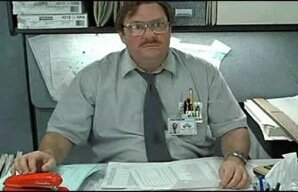
How unfortunate for the Democrats to have a candidate named Covert. If they try to donate to his campaign, the headlines will surely read "Democrats Fund Covert Operation". Perhaps a lack of funding explains why Covert's official website looks like a Geocities page from 1996. Ken Miller, a state legislator, is well-funded and has a professional website proclaiming his dislike for spending of any kind, and he will let his conservative values guide him. Current state treasurer Scott Meachem, a Democrat, is not running for another term and has endorsed Miller, a Republican. But Stephen E. Covert is the only one to point out the constitutional limitations on the office of the treasurer, pointing out that his opponent is going around acting like he can make policy. And Covert is, as he puts it, the only CPA in the race, even if his low-technology style does give his official campaign photo a passing resemblence to the stapler guy from Office Space. Can't you just picture Covert fondling a Swingline in his left hand?

My vote: Covert

Superintendent of Public Instruction
Janet Barresi - Republican
Susan Paddack - Democrat
Richard E Cooper - Independent

Barresi is the founder of two successful charter schools and is also a dentist. Paddack is a state senator from Ada and a former science teacher. Cooper is an educator also from Ada. Barresi is for expansion of charter schools, testing reform, and local control of schools. She is adamantly opposed to State Question 744, although she does misrepresent its accountability measures (Barresi thinks there will be no invoice telling how the money is spent, but one of the few things SQ 744 does mandate is that there will be a report published telling how the money is spent). Paddack is hard to pin down. She has refused to take an official position on SQ 744. Cooper is all for SQ 744. According to this Oklahoma Gazette profile, none of them seem to have a response to the perceived exodus of teachers to other higher-paying states (Paddack: Please stay! Barresi: We'll get rid of some onerous rules for you. Cooper: We'll get creative about job titles.) I heard part of a debate among the three candidates this past week as I was waiting for a tow truck to show up, and I found Paddack and Barresi to be well-spoken and assured, even though it was still hard to determine exactly what Paddack was for. For what it's worth, Paddack has the endorsement of Brad Henry and the Norman Transcript, while Barresi has the endorsement of Senator Jim Inhofe and the Oklahoman.

I think there are lots of reasons to vote for any of these candidates. I like Barresi's "research-based" strategies and her openness to merit pay for teachers, but I also like the fact that Paddack is less likely to be in favor of vouchers and "local control". It seems that conservatives really like Barresi, which I think is enough to turn me to voting for Susan Paddack.

Commissioner of Labor
Mark Costello - Republican
Lloyd L Fields - Democrat

Lloyd Fields famously ended up in the detox center in Oklahoma City after a night where he "attempted to steal a professional bull rider's guitar". He also has been sued for "political harassment" and back child support. Republican Mark Costello has jumped all over this story. He got the professional bull rider to support him. He made a Jib-Jab-like video of all of the rest of Fields' misdeeds. And he even found time to record a jingle for himself to the tune of Mellow Yellow, with the lyrics "Vote for Mark Costello (labor commish!)/ He's the right fellow (that's right!)". What this all has to do with the Department of Labor, I don't really know. The Norman Transcript supports neither candidate.

My vote: Costello

Insurance Commissioner
John Doak - Republican
Kim Holland - Democrat

Kim Holland, the only Democrat to be leading in the polls for statewide office, is more of an independent than a liberal. She is racking up endorsements from all over the political spectrum, including the right-leaning Daily Oklahoman (her website* lists them all). John Doak is obsessed with getting rid of the new federal health care law. He has joined a federal lawsuit against it. He has made an ad where all he does is talk about how much it removes choice. He is spearheading a yes on State Question 756 campaign (the one that says no to ObamaCare). He has even tied Holland to Obama in another ad (She was a delegate! How awful!).

My vote: Holland

*Note: If you're stumbling around online for information about the race for insurance commissioner, perhaps while making a blog post, don't decide to bypass the convenient Google search toolbar in the upper right corner of your screen and type in kimholland.com instead to see if there's anything there. Because there is something there, and it is incredibly NSFW.


U.S. Senator
Tom Coburn - Republican
Jim Rogers - Democrat
Stephen P. Wallace - Independent
Ronald F. Dwyer - Independent

I'm not going to vote for Tom Coburn, so this section will be about all those other guys. Today I ran across a piece written for Wonkette.com by Josh Fruhlinger, who also happens to run another of my favorite sites, the Comics Curmudgeon. The Wonkette piece is entitled "Grizzled Old Coot Will Be Oklahoma's Next Democratic Senator". Among the many theories about how Jim Rogers, the White Alvin Greene, got to be the Democratic nominee for U.S. Senate was that voters may have thought he was related to Will Rogers.

Jim Rogers is not in fact related to Will Rogers, although he is like Will Rogers in that he doesn’t have a website. But who needs a website when you have an enormous sign that you can hold up in the direction of oncoming traffic — a sign that, as near as we can tell, declares that “US MILITARY PD TINKER AFB USPS VETERANS FDX UPS TAX PAYERS OHP TRUCKERS OPE [...] CHURCH?”


As for the other two candidates, they both appear to be conservative Republicans in disguise. Tulsan Stephen P. Wallace actually has a website: he is for abolishing the "death/estate tax", a "fiscal freeze" on all federal branches of government, and "Constitutional Amendment for Balance the Budget." Ronald F. Dwyer, another Tulsan, is even more mysterious and, if possible, more grammatically incorrect. I have scoured the internet for some record of this Ronald F. Dwyer person, and all I can find is this statement he gave to the Oklahoma Prosperity Project, an organization tied to the Chamber of Commerce.

I have a program to be put into federal law that can increase the monthly income by $4,000+ of every man, woman and child in Oklahoma; Every business, company, organization, church, charity, etc. My program will eliminate unemployment, welfare programs, etc. My program will provide a new way to finance government (at all levels) by helping people make money instead of taxing (taking money) from the people. 'Welcome to the Golden Age!'


Oklahoma does not allow anyone to write in a candidate for office, unlike most other states. This proves to be a problem for me in this U.S. Senate race. I'm not going to vote for Coburn, Dwyer or Wallace, and I don't want to reward Jim Rogers for lucking into the Democratic nomination. I may just leave this one blank.

Judicial Retention

Supreme Court
Stephen W. Taylor
James R. Winchester

Both of these men are highly qualified. Taylor is a Brad Henry nominee, and Winchester is a Frank Keating nominee. I'm going to vote to retain both.

Oklahoma Court of Civil Appeals

Deborah Barnes
Doug Gabbard III
John Fischer
Larry E. Joplin

Muskogee Politico
, a right-wing blog, suggests voting no on retention of these judges because they were appointed by Democratic governors, and their vacancies would be filled by Mary Fallin, presumptive governor-elect. This is the reason I am going to vote to retain all four of these judges.

State Senator, District 16
Sharon Parker - Republican
John Sparks - Democrat

My vote: Sparks


State Representative, District 44
Kent Hunt - Republican
Emily Virgin - Democrat

My vote: Virgin


County Treasurer
Jim Reynolds - Republican
Mona Nelson - Democrat

The Norman Transcript has an article about this race
. Mona Nelson is a deputy county treasurer with 25 years of relevant experience. Reynolds is a state senator who is campaigning on being a conservative, and he hopes you'll agree with him that we need conservatives in all parts of the government.

My vote: Nelson


County Commissioner, District 3
Rusty Sullivan - Republican
Jim Robertson - Democrat

The Norman Transcript also has an article about this race. Jim Robertson, a "graduate of life experience," is challenging Commissioner Rusty Sullivan, a Republican with endorsements from local Republicans and some local Democrats. Jim Robertson wants to stand up to unspecified "men in suits" responsible for certain misdeeds in the county. Both men want to build roads.

My vote: Sullivan


District Judges

Tracy Schumacher
Jonathan Nichols

Norman Transcript article.

Schumacher has experience as a defense attorney. This simple fact has caused her to be labeled "soft on crime" by Nichols, a Republican state senator. But this world needs more defense attorneys as judges.

My vote: Schumacher

Greg Dixon
John Mantooth

Norman Transcript article.

Mantooth is able to self finance most of his campaign. Dixon was a former football player for Barry Switzer. Neither of these facts really sway me that much.

My vote: Dixon

Jeff Harley Bryant
Tom Lucas

Norman Transcript article.

Lucas has apparently been there for a long time and is competent and well-liked.

My vote: Lucas

Charles L. Broadway
Lori Walkley

Norman Transcript article.

Charles Broadway has been adding little stickers to his signs all over town stating that he is the "true conservative".

My vote: Walkley


Friday, October 29, 2010

The Friday Before the Election

So Bill Clinton urged Kendrick Meek to quit the Florida senate race in order to possibly swing the race to nominally-independent moderate Republican Charlie Crist over Tea Party-backed conservative Republican candidate Marco Rubio. I first read about this story last night, and the thing that caught my attention was not so much the backroom dealmaking as the presumption that Marco Rubio is on "the cusp of national stardom." I think they may be right. All other Tea Party candidates with high profiles (Christine O'Donnell, Sharron Angle, Rand Paul, Ken Buck, and others) have made some extreme statements about certain things. I have not yet heard of Marco Rubio saying something dumb. An ascendant conservative known having a fiery personality and not known for saying stupid things could definitely gain a higher profile before 2012 or 2016, especially since he will be known in January as Senator Marco Rubio.

Oklahoma's gubernatorial candidates had a debate last night, only five days before the election. The headline I read in the Norman Transcript is "Governor Opponents Boast Right Leanings." Well, just great. It's a race to the right, apparently. Ironically it was the Democrat (Jari Askins) calling out the Republican (Mary Fallin) about her "yes" vote for the TARP bank bailout (signed into law by George W. Bush, but supported by Barack Obama). Jari Askins reinforced her self-imposed "conservative Democrat" label by pointing out how fiscally conservative she was in comparison. The candidates also got asked about Sarah Palin, for some reason. Jari Askins called Sarah Palin a "strong communicator". As soon as Palin is able to communicate her favorite newspapers and her geographic knowledge of the location of Russia, Jari Askins will apparently let us know, presumably while she's "hunting grizzly bears" with her in Alaska. Needless to say, this run for the right favors Mary Fallin, who is against abortion, gun restrictions and health care, and for Arizona's immigration law.

Jim Priest, Democratic candidate for Oklahoma Attorney General, pointed out that his opponent Scott Pruitt has taken $62,000 (7% of his total donations) from poultry companies, which is an issue because of current Oklahoma AG Drew Edmondson's lawsuit against poultry companies in Arkansas for their pollution of Oklahoma waterways. Sure, $62,000 is chicken feed (ha) when it comes to buying influence, but Priest was trying to use it as a way to say that Scott Pruitt is someone who is opposed to clean water regulations from the EPA, and therefore, if elected, Scott Pruitt would be bad for Oklahoma rivers. At least, that's what I think he's trying to say.

Tuesday, October 26, 2010

Scott Pruitt: Another Ken Cuccinelli

There is only one week until the election, and this is usually the time where I start investigating the races that are maybe a little bit under the radar to me, down-ticket from Jari Askins or Mary Fallin. They're usually full of names I've heard of from yard signs and maybe the occasional NPR local news brief: Corn, Lamb, Baressi, Paddack, Priest. But I took notice for real when I read a news story about a particular attorney general from Virginia coming to the Sooner State to campaign for Republican attorney general candidate Scott Pruitt.

Ken Cuccinelli is proud to be known as a warrior against ObamaCare, but he's also known as a culture warrior dealing with other constitutional things besides the commerce clause and the supremacy clause; Cuccinelli is against non-discrimination policies that include sexual orientation, the separation of church and state, academic freedom, and a woman's right to choose, among other things. He's also proud to endorse and campaign for Scott Pruitt for Oklahoma AG. Virginia's top lawyer, who filed the first lawsuit in the country against the federal health care law just minutes after it was signed by Barack Obama, is endorsing Scott Pruitt in large part because Pruitt is proposing to start an office of federalism.

According to Pruitt's website, the Office of Federalism's "primary responsibility is to determine how the office can and should push back against Washington."

In addition to bringing suit against the Obama Administration’s newly passed health care mandates, the new Office of Federalism will defend Oklahomans against agencies such as the Environmental Protection Agency when its regulations seek to establish climate and energy policy absent congressional action, and the Nat'l Highway Traffic & Safety Administration in setting new fuel-economy standards.

Besides his dislike of the EPA and NHTSA, Pruitt would immediately sue the government over ObamaCare if elected, even if State Question 756, which would allow Oklahoma to opt out of ObamaCare (and which would be null and void upon passage due to the presence of the Supremacy Clause of the U.S. Constitution), doesn't pass. Cuccinelli wholly endorses SQ 756, calling it a question of the "dignity of the sovereign, the State of Oklahoma in this case." It would certainly be undignified of Oklahomans to pass such an unconstitutional law, supported by a state attorney general who supposedly is sworn to uphold the Constitution.

Scott Pruitt's rival in the election, Democrat Jim Priest, could certainly not be described as out of touch with Oklahoma values. He wastes 937 words on his campaign issues page retelling a story he wrote about his first gun. But compared to Scott Pruitt, Jim Priest seems like his middle name should be Delano. Ken Cuccinelli came to Oklahoma to say that he needs another extreme right-wing cultural warrior/demagogue for his fight against what Cuccinelli perceives as tyranny, and that Scott Pruitt is the man for the job. But the last thing we in Oklahoma need is another Ken Cuccinelli.

Thursday, October 21, 2010

Looking at the Mail

We got 5 pieces of campaign mail yesterday, by far the highest one-day total of this election season. One of them was for the campaign for Yes on 744, the state question that would increase spending on education by 20% without legislator influence. One was for Rusty Sullivan, a candidate for Cleveland County commissioner. I think he's a Republican, but he has what I think is a very effective ad depicting his bipartisanship. On my list of things to look up on the internet before I vote is exactly what the county commissioners do.

Two pieces of mail were from Emily Virgin (D), candidate for our district in the Oklahoma state house of representatives. She won the primary in July in a 4-person race that, judging by local lawn signs at the time, felt like it should have been closer. But Virgin, a former manager for the OU football team, won more than 50% of the vote and avoided a runoff. She canvassed the neighborhood way before I was even thinking about the election, and so when she rang the doorbell, I couldn't think of anything to ask her. Just last week she came by again to get out the vote for the November election, and I was slightly more prepared. Virgin uses the lesson in her campaign literature of a corporate tax break to a private space aviation company called Rocketplane that quickly went out of business as an example of money spent by the legislature that would be better put to use helping out both k-12 and higher education in the state. I asked her how she would be able to tell ahead of time that any particular corporate tax break would hurt the state more than help the state. She gave an answer indicating that it was the transferable nature of the tax break to Rocketplane that should have been eliminated; that Rocketplane should have been required to deliver the results rather than be allowed to sell the rights to the tax break to another company. She was more articulate that I can reproduce from memory. I don't think she answered my question exactly, but she sounded knowledgeable enough and I was impressed with her grasp of the concept.

One other piece of mail came from Aaron Stiles (R), who is running for a house district on the east side of Norman. My family cannot vote for him, so I don't know why we got this mail. But he is running against a Democrat named Wallace Collins, who has the reputation of being one of the more outspoken Democrats in the state legislature. And it got me thinking about the reframing of the health care law passed by the U.S. congress and signed into law by Barack Obama. It has now so thoroughly been relabeled as "Obamacare" that even "respectable" "blogs" like mine tend to refer to it as Obamacare just for brevity's sake. Stiles claims he has the "backbone to stand up to Washington, D.C. and keep ObamaCare out of Oklahoma," and that Wallace Collins voted against a bill "keeping ObamaCare out of Oklahoma". It's a crazy, twisted world when the candidate for office is labeled as soft on health care when he votes against exempting his state from tougher new federal health care laws.

We have not yet received a single piece of campaign mail from any politician running for governor, U.S. senator, or U.S. representative. Tom Cole, our Republican representative, is running unopposed, so this is no surprise. Tom Coburn, our Republican senator, is running against a homeless-looking man named Jim Rogers, a man who doesn't do any campaigning because it's "not his style", and who is one of those "perennial candidates," a class of individuals for whom no long shot is long enough. Tom Coburn definitely doesn't need to do anything to get the vote out. But we have a nominally competitive race for governor between current lieutenant governor Jari Askins (D) and former lieutenant governor Mary Fallin (R). I'm not as tuned in as I should be to local news, but I'm very tuned into yard signs and campaign mail.

Friday, October 15, 2010

State Questions!

Last night the League of Women Voters of Norman hosted a forum to discuss the 11 state questions that Oklahoma voters will encounter on the ballot in November. The panelists were Rick Tepker, a constitutional law professor at the University of Oklahoma; Rick Farmer, director of communication of the Oklahoma House of Representatives; and David Morgan, emeritus professor of political science at the University of Oklahoma. The moderator was Helen Duchon.

I thought the forum was extremely informative. I learned that apparently, unlike the constitution of the United States, which is short and vaguely-worded, the Oklahoma constitution is complicated and long, and that no one really knows what's in it. Rick Farmer said that a printer at the capital had to be manually shut off because it was being tied up by an aide who wanted a copy of the entire constitution and had been printing for hours. The panelists all shared a laugh at the expense of a state lawmaker who wanted print services to make a pocket-sized version of the Oklahoma constitution that he could carry with him. Rick Tepker posited that such a document would have to have such a tiny font that the whole thing would appear to the naked eye to be page after page of black sheets, as if the whole document was some redacted version of itself.

All this levity about the length of the Oklahoma constitution was in response to questions from the audience primarily about state questions 744 and 754. State question 744 is a measure that would constitutionally require Oklahoma to fund k-12 education at the same per-pupil level as all six of the states that share a border with Oklahoma, regardless of the status of the rest of the budget. In other words, a predetermined constitutional formula based on how much other states spend on education. State question 754 is a measure that would revoke all such predetermined constitutional formulas and formulas based on how much other states spend on anything. The constitutional law professor Tepker said that if either or both of these pass, the result will be litigation. Lots of it. Because no one really knows if legally these two questions can peaceably exist within the same state constitution. And apparently no one knows how state question 754 affects other previously-passed statutes, statutes which may or may not exist, and if they do exist, there may be something like 20 of them, but no one can say for sure because the constitution is so long and, apparently, unprintable.

There also may be a relevant statute to this question, brought up by both Farmer and Tepker, that states that if both of these conflicting statutes pass, then the one with the most votes will be law and the other one would be, I guess, S.O.L. And one other aspect to state question 754 is that it cannot be repealed or amended if it is adopted. And we know this only because that's what it says about itself. Whether a law can make itself unrepealable is still a matter of debate and will certainly be decided in the courts, says Tepker, who is of the opinion that most of the state questions are terrible for the public but would be great for the employment of lawyers.

State question 744 deserves some extra attention because it is, according to Tepker and most everybody who follows these things in Oklahoma, the most important measure on the ballot. It mandates a substantial spending increase for education (close to 20% of the education budget, or $1.0 to $1.7 billion per year, according to Tepker) without any sort of plan to increase the state's revenues to pay for it. The website for the proponents of 744 claims that it can be paid for by eliminating legislator perks and pork barrel projects; or in other words, stuff that will never be eliminated by any legislature anywhere (sorry to break it to you, Tom Coburn). Tepker was asked how the proposal would be funded if it were to pass, and Tepker replied that since the Republicans would likely be in charge of the legislature, a tax increase would be even more unlikely than usual, and that the legislature would have to find ways to cut spending in other areas of government. Some critics of the measure claim that a 20% cut would be necessary across the board. And there are no strings attached to the money, beyond that it has to be spent on instruction costs, not debt relief or construction of new buildings. In other words, no new academic standards or testing would be required. Rick Tepker said that Oklahoma would become California in terms of fiscal gridlock if 744 passed, which isn't likely, according to poll numbers conveyed by panelist David Morgan. Only 27% of people support 744 now, which is down almost 40% from a poll in July. I brought with me to the forum a whole bunch of questions that I had planned to ask about the details of education funding from other states, and how it would fit in with local and federal mandates, and all kinds of arcane things that aren't really that relevant now that I see that 744's support is dwindling.
But there are plenty of other half-thought-out measures that apparently are very popular in the Sooner state. State question 751 is a measure that will allow the state to conduct its business in English only, if it wants. There are some exceptions for federal forms and for tribal languages, but the measure says that if passed, it would prevent the state from being sued for not providing non-English documents. According to Rick Farmer, a woman in Jenks sued the state because the state refused to offer her a drivers license test in Farsi. The lawsuit was quickly thrown out of court. By passing state question 751, the lawsuit could apparently be thrown out of court more quickly, according to Rick Farmer. The English-language-only state question has the support of 85% of the citizens of Oklahoma.

There is a voter ID law on the ballot. State question 746 would require voters to present a valid government issued photo ID in order to vote. 3 other states have tried this, and the Supreme Court threw out a challenge to a similar law in Indiana (which I have previously talked about and made made a graph for). The usual arguments for and against were conveyed by David Morgan (who, I must say, has an excellent voice for radio and public speaking): it could disenfranchise a number of poor or elderly people, but it prevents fraudulent voting to a certain extent. According to Morgan, the editorial board of the venerated Daily Oklahoman claims that if the measure prevents even one fraudulent vote, then it would be a worthy law, no matter how many people (Democrats) it disenfranchised. Most of those in attendance last night were not sympathetic to the Oklahoman's opinion, but a poll puts those in support at 43% and against at 35%.


The question that got constitutional law professor Rick Tepker riled up the most was state question 755. SQ 755 would prohibit Oklahoma courts from using or considering international law or Sharia law when deciding cases. Tepker called it "offensive" with language that is "overbroad." He pointed out that it would also remove any basis for consideration of English common law, the historic root of the U.S. Constitution; and also for the ten commandments, which are popular 'round these parts. But it is all moot anyways; all that state question 755 could do would be to uphold the oaths to uphold the constitution that judges must swear to do already.

Another pointless headline-grabbing state question deals with "Obamacare". State question 756 would prohibit forcing any person or employer to participate in the federal health care law. Rick Tepker railed against this question as well, saying that "if it passes, it does nothing, I repeat, nothing to make the [federal] health care law unconstitutional," and it also does nothing to make it constitutional. Since the U.S. Constitution's Supremacy Clause trumps whatever our state does, the law will have no effect except to be reported on by the "lamestream" media. Tepker believed that the law would be deemed "null and void" immediately upon passage, which would mean no disruption in Medicare funding for Oklahomans. He compared it to the city council of some town in Vermont declaring that the war in Iraq is unconstitutional; a plea for attention worth nothing.

The rest of the measures on the ballot are not overtly controversial, but they still reflect the political composition of the conservative legislature that put them on the ballot. State question 747 would put term limits on all the statewide elected offices that don't already have term limits, such as lieutenant governor, attorney general, treasurer, labor commissioner, corporation commissioner, state auditor, and the state schools superintendant. And you thought entrenched interests only existed among politicians whose name you had heard of. Brad Henry, our term-limited Democratic governor, opposes the measure (sour grapes?). David Morgan revealed that 69% of voters were in favor of this measure, which Rick Tepker complained would take away the ability of the voters to elect the best person for the job if that person had already served 8 years.

State question 750 is a measure whose effect is to lower and make relatively consistent the number of signatures required to get a state question on the ballot. Currently in Oklahoma, one needs to collect a number of signatures equal to a certain percentage of the voters in the previous statewide election, held every 2 years. State question 750 would set the threshhold at the same percentage of voters, but count the voters for the statewide election for governor only, an election that always features a lower turnout than the one for president. It's a complicated explanation for a state question, David Morgan said, which is why there is no polling data on it. When asked if there was anything in the measure to prevent frivolous petitions, Morgan replied that silly questions would still be allowed, and that state question 750, if it would have any effect, would probably result in more state questions on ballots in the future. Another related question led to a lecture by Rick Farmer about the history of state questions. A third of state questions have come from people circulating a petition, but were less likely to pass than the two-thirds of state questions that have come from the legislature. The eleven state questions on the ballot this year (state question 744 from petition, all others from the legislature) are in fact a new record.

The apportionment commission is the subject of state question 748, and if you've never heard of this commission, it might be because it has never, in the entire history of statehood, actually convened a meeting. The apportionment commission is set up to meet if and only if the legislature fails to act on redrawing state house, state senate, and congressional districts in the legislative session following the decennial national census. The apportionment commission would be changed from a commission controlled by possibly-partisan statewide office holders (attorney general, state superintendant, treasurer) with no skin in the map-redrawing game, to a commission controlled by the governor, the speaker of the state house, and the president pro-tem of the senate. Legislators put state question 748 on the ballot as a measure that would give legislators more power (but only theoretically) over decisions that affect legislators, in the event that legislators cannot act on the matter before then. David Morgan said that there was no polling data on this question.

A shift toward legislative branch power is also the point of another ballot measure about a commission most people don't care about. State question 752 adds a couple of people and a couple of rules about the existing people on the Judicial Nominating Commission, which meets to select a list of nominees that the governor can appoint to the state supreme court. Currently the commission is composed of 13 people, with 6 non-lawyers appointed by the governor. State question 752 would add two more people, chosen by the house speaker and president pro-tem of the senate; and it would also mandate that the six non-lawyers must also not have a lawyer in their immediate family. In addition to making me ineligible to be one of the governor's choices on the commission (oh drat!), state question 752 also has the effect of shifting power ever so slightly away from the American Bar Association and towards the state legislature, according to Rick Farmer. Farmer recommends that if one is pro-ABA, one should vote no on this measure, and if one is anti-ABA, one should vote yes on this measure.

The one remaining state question involves the state's Rainy Day Fund, which has a more formal name that I forgot to write down when I was taking notes. State question 757 would raise the limit on the Rainy Day Fund from 10% of the budget to 15% of the budget. Oklahoma topped out the Rainy Day Fund for a couple of years before the recession of 2008, according to Farmer, and the fund has apparently helped out with the economic situation in the state since then. Rick Farmer characterized three positions from the political left, right, and center. He says the left would look at surplusses as evidence that the government should spend more, the right would look at it as evidence that the government should tax less, and centrists would look at it like a savings account where the state could tuck some money away for, as they say, a rainy day. Savings accounts are popular with many people in the center, according to Farmer, and indeed, poll numbers show support for the measure at 53%, compared to 29% against, according to David Morgan.

After the question and answer session, moderator Helen Duchon asked the panelists if there were any state questions that they would actually vote yes on. Rick Tepker answered first and advised skepticism generally for all state questions. He loathes with a passion state questions 755 (Sharia Law) and 756 (Obamacare), and he wouldn't vote yes on any of them, with the possible exception of 752 (Judicial Commission) and 757 (Rainy Day Fund). David Morgan pointed out tactfully that many of the questions were intended to get "a certain political party's base" out to the polls to vote. He too would vote no on all of the measures, except for maybe the unimportant ones. Rick Farmer ended by saying, "I am an at-will employee of the speaker of the house," and then gave out the recommendations of speaker Chris Benge (R-Tulsa): no on 744 (Education Funding), yes on everything else. This elicited gasps of displeasure from the audience.

___

A numeric guide to the state questions on the 2010 Oklahoma ballot:

744 = public education funding (the big one)
746 = voter id law
747 = term limits for low-profile statewide offices
748 = apportionment commission, the one that's never met
750 = petition signature threshhold
751 = English only
752 = judicial nominating commission, the one with all the lawyers
754 = no predetermined constitutional formulas, or, the anti-744
755 = no Sharia law
756 = no Obamacare
757 = rainy day fund increase